One of the most profitable bonanza silver mines in the American west, it was owned by the Ontario Silver Mining Company, of which George Hearst, James B. Haggin, and Lloyd Tevis were the principal owners. Born in Ohio in 1832, Chambers joined the California Gold Rush, arriving at Sacramento in 1850. He worked in California’s gold fields as a placer miner and in the mercantile business. In 1869, he sold his business and returned to mining, first in Nevada and then Utah, where he met George Hearst. Chambers traveled to Montana in 1871 to scout mining properties for Hearst. He returned to Utah, where Marcus Daly had recommended that Hearst acquire the Ontario mine. Chambers purchased the mine for Hearst in 1872, and Hearst made him superintendent. After Daly moved to Butte to develop the Alice mine on behalf of the Walker Brothers, he secretly wrote to Chambers, recommending that Hearst take an interest. That all came to pass in 1881, when Daly bought the Anaconda mine and enlisted Hearst, Haggin, and Tevis to invest in its development.
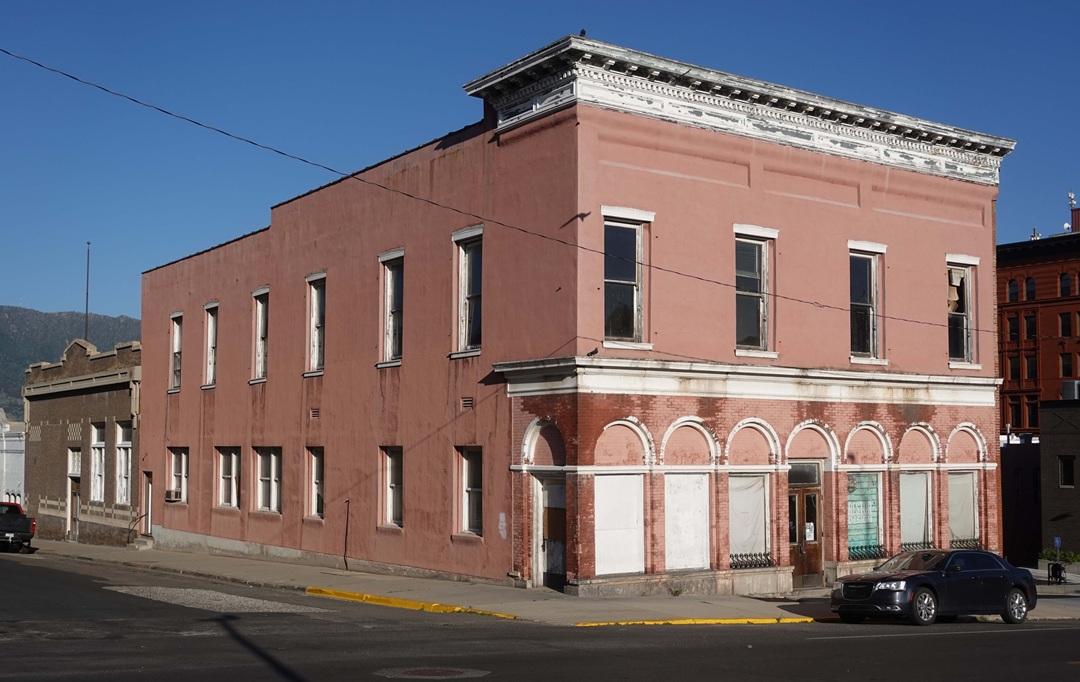
Chambers and Hearst travelled to Butte in July 1881 to help Daly start sinking the shaft of the Anaconda mine. Later that year, Chambers contracted with James Renshaw to build a two-story brick building at the southeast corner of Quartz and Main to house the bank, Hoge, Brownlee & Company. Daly, Hoge, Brownlee, Chambers, and F.E. Seargent were principles in the bank. Construction of the building began in late 1881 and was completed in early spring 1882. Counters and other bank fixtures arrived from San Francisco in March. Other renters in the Chambers Block in 1882 included surveyors Barker and Harper; F.R. McConnell, general western agent for the Union Pacific Railway, which had just inaugurated rail service to Butte; and Marcus Daly.
Although Chambers’ main job remained managing operations at the Ontario mine in Park City, he and his building in Butte continued to play roles in the development of the Anaconda mining enterprise. While Daly and his investors had bought and were developing the Anaconda and adjoining St. Lawrence mines, Chambers became nominal head of a group of investors, called the Chambers Syndicate, who started buying other mining claims higher on the Butte hill, including the Mountain Consolidated, Modoc, Green Mountain, and High Ore. Development of those properties, called the Syndicate group of mines, was managed by the Anaconda company, and by the late 1880s, the Syndicate mines were also sending ore to the Anaconda smelters.
When the Anaconda Mining Company incorporated in 1891 under the laws of Montana, it held its annual stockholders’ meetings in the Chambers Block in what was called the office of the company (rooms 1 and 3). Beginning in 1893, the Anaconda Mining Company held its stockholders’ meetings in the Tuttle Block, which had been built across Quartz Street in 1892. When the company reorganized as the Anaconda Copper Mining Company in 1895, it continued to use the Tuttle Block for meetings.
Meanwhile, the bank of Hoge, Brownlee & Company continued to occupy the corner storefront of the Chambers Block until it changed its name in early 1899 to Marcus Daly and Company. Owners of the bank were now Daly, J.B. Haggin, and Michael Donahoe, who was vice president and general manager of the Butte, Anaconda & Pacific Railway. After the bank hired William L. Moyer from Chicago in July 1899 to manage the business, the bank again changed its name to Daly, Donahoe and Moyer. Daly died in 1900, and early in 1901, a new company, Daly Bank and Trust incorporated, with W.W. Dixon (long-time attorney for Marcus Daly and the Anaconda enterprise) as president and John D. Ryan as vice president. Ryan became president of the bank in 1902, beginning his rise in the Anaconda world. The Daly Bank moved into the former State Savings Bank Building on the southwest corner of Park and Main in 1916 and changed its name to the Metals Bank and Trust Company in 1920. Since then, it has been known as the Metals Bank Building. After the Daly Bank moved, ACM acquired the Chambers Block and remodeled the first and second floors in 1917 to serve as ACM paymaster’s office.
]]>