<?xml version="1.0" encoding="UTF-8"?>
<feed xmlns="http://www.w3.org/2005/Atom">
  <title type="text">Story of Butte</title>
  <updated>2026-08-10T16:24:42+00:00</updated>
  <generator uri="http://framework.zend.com" version="1.12.20">Zend_Feed_Writer</generator>
  <link rel="alternate" type="text/html" href="https://storyofbutte.org/"/>
  <link rel="self" type="application/atom+xml" href="https://storyofbutte.org/items/browse?output=rss2"/>
  <id>https://storyofbutte.org/</id>
  <author>
    <name>Story of Butte</name>
    <uri>https://storyofbutte.org</uri>
  </author>
  <link rel="hub" href="https://pubsubhubbub.appspot.com/"/>
  <entry>
    <title type="html"><![CDATA[Gainor House]]></title>
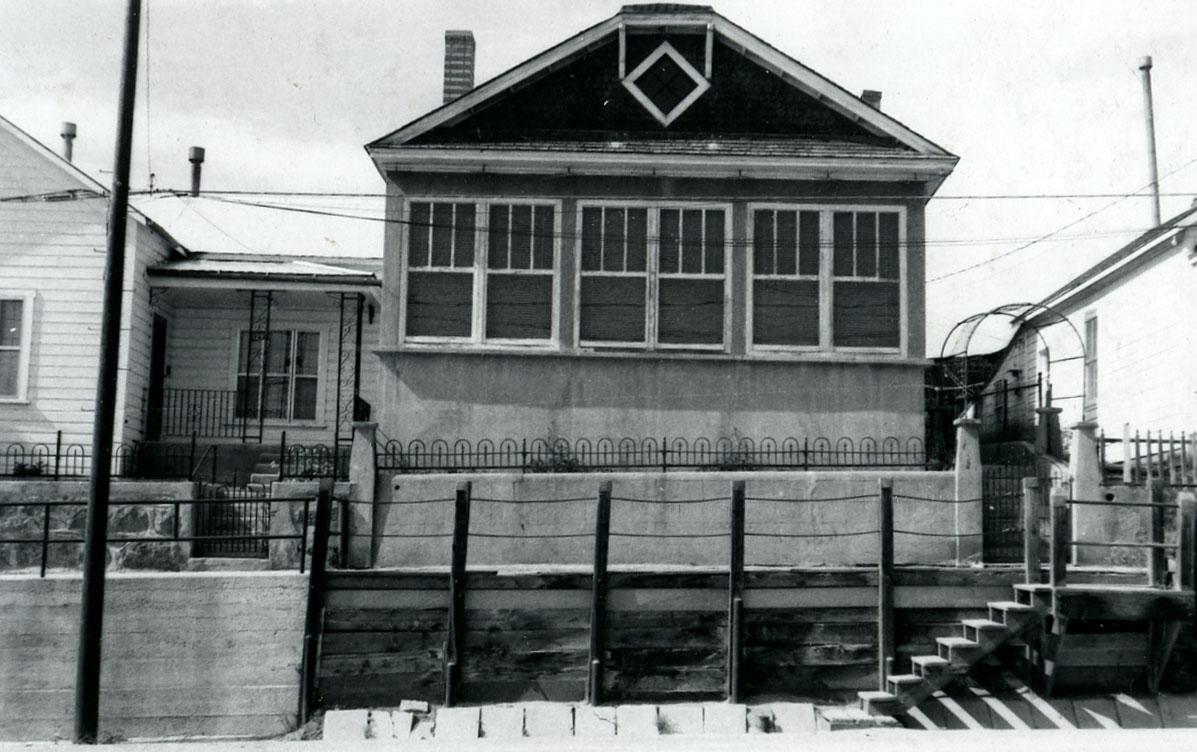
    <summary type="html"><![CDATA[<p><strong><em>Rows of wood-frame houses lined West Daly Street by 1884 when it was still part of Chickentown, a Walkerville suburb.</em></strong></p><img src="https://storyofbutte.org/files/fullsize/6d651e8136f772e509b73d3bc8dd2802.jpg" alt="127 West Daly Street" /><br/><p> By 1891, Walkerville had absorbed Chickentown, and this house was the only brick-clad home on West Daly. Butcher Louis T. Gainor and wife Julia purchased the home in 1898, later adding a two-story rear addition by 1916 and stucco cladding after 1930. Louis, a successful meat market owner, served one term as Walkerville mayor in 1902-03. He owned one of Butte’s first cars, and his custom-made White Steamer runabout nearly won the Montana State Fair’s first-ever auto race in 1906. He narrowly lost when it burst into flames. In 1914, Julia joined one hundred local women campaigning against women’s suffrage. The group declared that giving women the right to vote was “progressive only in name” because of the “great responsibilities which it would add to the already manifold duties and responsibilities in woman’s life.” Louis and Julia shared the home with their daughter Virginia and son-in-law William Hunter until they died in the 1940s. Virginia and William remained in residence until 1959.</p><p><em><strong><a href="https://storyofbutte.org/items/show/3472">For more view the original article</a></strong></em></p>]]></summary>
    <published>2024-01-05T18:23:20+00:00</published>
    <updated>2026-04-17T19:58:09+00:00</updated>
    <link rel="alternate" type="text/html" href="https://storyofbutte.org/items/show/3472"/>
    <id>https://storyofbutte.org/items/show/3472</id>
    <author>
      <name>Montana Historical Society</name>
    </author>
  </entry>
  <entry>
    <title type="html"><![CDATA[Schonsberg&#039;s Grocery and Saloon]]></title>
    <summary type="html"><![CDATA[<img src="https://storyofbutte.org/files/fullsize/63a13c17fa00dcebbf06ccc4f3883081.jpg" alt="307 West Daly Street" /><br/><p>In 1891, Swiss-Italian immigrant Peter Schonsberg established his residence and grocery store in a one-story wood-frame building built in 1884. Peter, wife Pacifica, and six children lived in the western third while the store occupied the eastern two-thirds. In 1900, contractors jacked up the building and placed a full-story stone foundation under it. They also built up the stone house to the west and attached the false-front stone building on the east, where Peter opened a saloon. Peter died in 1915 at age fifty-nine and Pacifica died at age forty-two in 1916. Their married daughter Adeline Rodoni raised her five younger siblings (and her children), while husband Julius and partner Felix Tatti ran the store and saloon. Prohibition closed the saloon, but by 1920, Schonsberg’s oldest son Valerio, his wife Lizzie, and sister Linda were operating the grocery store, while the extended family lived upstairs. Valerio reopened the saloon after 1933, running it until he retired in 1971. Lizzie and daughter Valerie established The Alpine Bar in Meaderville in the mid-1940s. After Lizzie died in 1969, Valerie kept The Alpine until her death in 2010.</p><p><em><strong><a href="https://storyofbutte.org/items/show/3471">For more (including 2 images) view the original article</a></strong></em></p>]]></summary>
    <published>2024-01-05T18:18:37+00:00</published>
    <updated>2026-04-17T19:58:09+00:00</updated>
    <link rel="alternate" type="text/html" href="https://storyofbutte.org/items/show/3471"/>
    <id>https://storyofbutte.org/items/show/3471</id>
    <author>
      <name>Montana Historical Society</name>
    </author>
  </entry>
  <entry>
    <title type="html"><![CDATA[Dreeland House]]></title>
    <summary type="html"><![CDATA[<img src="https://storyofbutte.org/files/fullsize/341ae1da76d0cd1480b058d95c43d2ce.jpg" alt="311 West Daly Street" /><br/><p>The second story of this residence, built circa 1884, dates to Walkerville’s formative days. Irish native John Dreeland may have been the first resident. He immigrated to the U.S. in 1869 to pursue mining. By 1884, he had settled on still-developing West Daly Street and was a partner in Butte’s Montana Union Publishing Co. In 1886, he opened the Butte Brewery Depot saloon. The next year, he and George Pascoe patented the nearby Colonel Sellers vein, a manganese mine. John, wife Bridget, and their three children lived here in 1900 when copper king William A. Clark funded construction of Butte’s streetcar line into Walkerville via West Daly Street. To build the line, contractors had to lower the street level by 2.5 feet. Some homeowners added retaining walls and stairs to their front property line, while others, like Dreeland and Peter Schonsberg next door, jacked up their wood-frame homes and built new stone walls under their existing buildings. After 1907, a succession of Italian families lived here. Timber contractor Maggiorino “Mudge” Tamietti and wife Sadie were long-time residents from 1931 until Sadie’s death in 1965.</p><p><em><strong><a href="https://storyofbutte.org/items/show/3470">For more view the original article</a></strong></em></p>]]></summary>
    <published>2024-01-05T18:15:32+00:00</published>
    <updated>2026-04-17T19:58:09+00:00</updated>
    <link rel="alternate" type="text/html" href="https://storyofbutte.org/items/show/3470"/>
    <id>https://storyofbutte.org/items/show/3470</id>
    <author>
      <name>Montana Historical Society</name>
    </author>
  </entry>
  <entry>
    <title type="html"><![CDATA[Reed House: 10 O&#039;Neill, Walkerville]]></title>
    <summary type="html"><![CDATA[<img src="https://storyofbutte.org/files/fullsize/c7bfbd2e52c00386a47def79f249a002.jpg" alt="10 O&#039;Neill St., Walkerville, MT" /><br/><p>Simple four-room worker cottages like this one provided basic accommodations for miners. This well-preserved example, built circa 1890, retains its original footprint, wood windows and doors, and lapped wood siding. It originally included two bedrooms, a living room, a kitchen, and an outhouse near the alley. Life for miners was often rough. John B. Kelly, in residence from 1898 to 1900, was badly beaten and left for dead following a night of drinking in September 1898. John’s friends found him alive in a prospect hole with serious head injuries and a fractured collar bone. In 1902, miner Michael Reed, his wife Mary, and their two children moved here. The Reeds had three more children and, in 1912, were hosting two boarders when Michael died of tuberculosis. Then, in 1914, Mary died of diabetes. Initially, Michael’s sister Mary Casey cared for the children and rented this house to other miners. By the mid-1920s she and the Reed children had returned to live here and at No. 12 next door. The oldest sibling, Thomas Reed and his wife Agnes, lived here from 1934 to 1971.</p><p><em><strong><a href="https://storyofbutte.org/items/show/3331">For more (including 3 images) view the original article</a></strong></em></p>]]></summary>
    <published>2021-07-20T20:40:13+00:00</published>
    <updated>2026-08-10T16:24:42+00:00</updated>
    <link rel="alternate" type="text/html" href="https://storyofbutte.org/items/show/3331"/>
    <id>https://storyofbutte.org/items/show/3331</id>
    <author>
      <name>Montana Historical Society</name>
    </author>
  </entry>
  <entry>
    <title type="html"><![CDATA[723 West Daly (Dewey Point): Residence of Bandmaster for the Alice Mine]]></title>
    <summary type="html"><![CDATA[<img src="https://storyofbutte.org/files/fullsize/76c25d8af4a83ac1faa61cff88a840cf.jpg" alt="723 West Daly (Dewey Point)" /><br/><p>Shortly after F. J. Brule’s 1906 survey, Walkerville carpenter Ed Reimel built this one-and-one-half-story, brick-veneered home with extended eaves and a hipped roof dormer with flared ends. Victorian elements include beveled glass windows in the gable end, segmented arch accents over the windows, and a hairpin fence providing symbolic protection from the outside world. Cornish immigrants John and Mary Rich were the first owners. John worked as a bookkeeper. He was also bandmaster for the Alice Mine and Mill Band and secretary of the Musicians Mutual Protective Union. In 1917, as a musician at the Rialto Theater, he doubtless played the sound tracks for silent movies. Mary was in women’s groups including the Miriam Rebekah Lodge #3 and the Walkerville Circle #547, Neighbors of Woodcraft. In 1924 the Riches moved down the street to a smaller home. From 1925 to the 1940s, this was home to William Richards, co-lessee of the Goldsmith Mine, and his wife Bessie and their four children. Their daughter Lavina lived here until 1990. </p><p><em><strong><a href="https://storyofbutte.org/items/show/2387">For more view the original article</a></strong></em></p>]]></summary>
    <published>2016-12-13T23:29:01+00:00</published>
    <updated>2026-04-17T19:58:06+00:00</updated>
    <link rel="alternate" type="text/html" href="https://storyofbutte.org/items/show/2387"/>
    <id>https://storyofbutte.org/items/show/2387</id>
    <author>
      <name>Montana Historical Society</name>
    </author>
  </entry>
  <entry>
    <title type="html"><![CDATA[119 West Daly: Butte National Historic Landmark District]]></title>
    <summary type="html"><![CDATA[<img src="https://storyofbutte.org/files/fullsize/57e74af5521714d6bda14a3c106b224b.jpg" alt="119 West Daly" /><br/><p>Joseph Walker, president of the Alice Gold and Silver Mine, platted the streets near his mine to provide convenient housing for mine workers. However, when he sold the lots, he kept the mineral rights. By separating mineral rights from property rights, the mining company retained permission to tunnel beneath area homes, a fact that deterred home owners from investing heavily in their houses. By 1891, a shotgun house stood here, part of a crowded residential block. Saloonkeeper John French purchased the property in 1892, which soon accommodated a one-story hipped-roof cottage. A second small home and an outbuilding with an attached chicken coop stood behind the main house. By 1910, French had left the saloon business to deliver coal and wood by wagon. He and his wife Cassie occupied the front house while brothers Dan and James Caddigan, both miners, lived in the back house. After John died in 1912, Cassie remained in residence until 1921, when she sold the property to Ursulla Hawthorn. During the 1960s, as part of “urban renewal,” the city demolished the rear house and outbuildings.</p><p><em><strong><a href="https://storyofbutte.org/items/show/2371">For more view the original article</a></strong></em></p>]]></summary>
    <published>2016-12-13T23:29:00+00:00</published>
    <updated>2026-04-17T19:58:06+00:00</updated>
    <link rel="alternate" type="text/html" href="https://storyofbutte.org/items/show/2371"/>
    <id>https://storyofbutte.org/items/show/2371</id>
    <author>
      <name>Montana National Register Sign Program</name>
    </author>
  </entry>
  <entry>
    <title type="html"><![CDATA[61 Bennett: Butte National Historic Landmark District]]></title>
    <summary type="html"><![CDATA[<img src="https://storyofbutte.org/files/fullsize/b52aabfcfd48b6cc4c07d86030b2bbc0.jpg" alt="61 Bennett" /><br/><p>Almost a quarter of the buildings in Walkerville are four-square, hip-roof residences, what housing catalogs called “workingman’s cottages.” Quick and inexpensive to build, they provided homes for Walkerville miners and their families. Roughly a third of those miners emigrated from England, many of them from the copper mining district of Cornwall. James and Edith Burnett lived here by 1910, with their two children and two of James’s older brothers, John and Steven. All three men worked as miners. Their father was originally from Cornwall, but the brothers grew up in Lancashire, where their dad mined iron. John was the first of the brothers to seek his fortune in Butte, leaving England in 1898. James was next, arriving in Butte in 1902, followed by Edith and the children in 1906, and Steven in 1909. It seems that James left the mining life behind as quickly as he could. By 1920, the family had moved to Oakland, California, where James worked as a railroad machinist. By that year, another family of English immigrants occupied the residence: fifty-three year-old miner William Rowe and his wife Martha.</p><p><em><strong><a href="https://storyofbutte.org/items/show/2194">For more view the original article</a></strong></em></p>]]></summary>
    <published>2016-07-25T16:29:52+00:00</published>
    <updated>2026-04-17T19:58:06+00:00</updated>
    <link rel="alternate" type="text/html" href="https://storyofbutte.org/items/show/2194"/>
    <id>https://storyofbutte.org/items/show/2194</id>
    <author>
      <name>Montana National Register Sign Program</name>
    </author>
  </entry>
</feed>
