<?xml version="1.0" encoding="UTF-8"?>
<feed xmlns="http://www.w3.org/2005/Atom">
  <title type="text">Story of Butte</title>
  <updated>2026-04-17T19:58:11+00:00</updated>
  <generator uri="http://framework.zend.com" version="1.12.20">Zend_Feed_Writer</generator>
  <link rel="alternate" type="text/html" href="https://storyofbutte.org/"/>
  <link rel="self" type="application/atom+xml" href="https://storyofbutte.org/items/browse?output=rss2"/>
  <id>https://storyofbutte.org/</id>
  <author>
    <name>Story of Butte</name>
    <uri>https://storyofbutte.org</uri>
  </author>
  <link rel="hub" href="https://pubsubhubbub.appspot.com/"/>
  <entry>
    <title type="html"><![CDATA[Labor Unrest and the Anaconda Road]]></title>
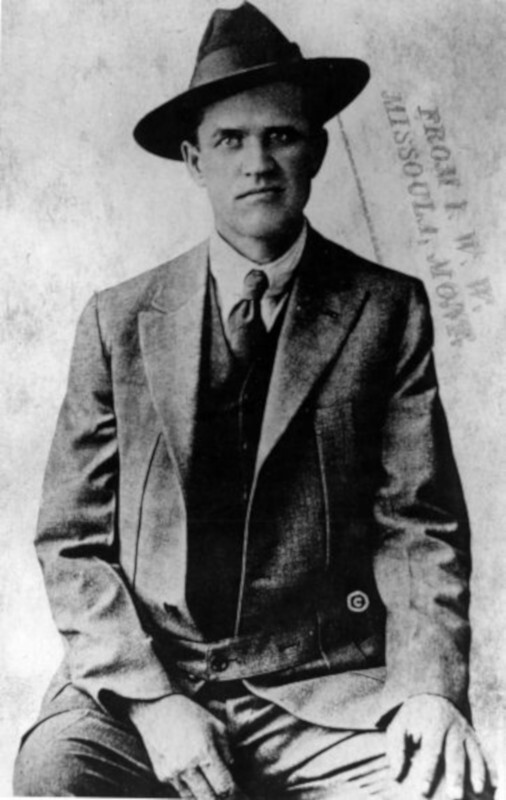
    <summary type="html"><![CDATA[<p><strong><em>Butte’s first miners’ union was organized in 1878, when miners at the Alice and Lexington mines went on strike. The Alice Gold & Silver Mining Company and A.J. Davis acceded to the miners’ demands, and the Butte Workingmen’s Union formed.</em></strong></p><img src="https://storyofbutte.org/files/fullsize/8f1942310cae5df3d6ae1d76551a4fc7.jpg" alt="Anaconda Road in Vicinity of the Anaconda Road Massacre" /><br/><p>The union movement grew, in part because the mining industry in Butte was rapidly growing at the time, with many new companies launching operations. Being in a remote part of the United States, far from population centers, Butte faced labor shortages, so the mining companies had to compete to find workers, putting labor unions in a strong bargaining position. The Butte Workingmen’s Union changed its name to the Butte’s Miners’ Union (BMU) in 1885 and helped to form local unions to represent other trades in the mining industry as well as trades working in the broader Butte economy. In 1886, the BMU assembled those other local unions into the Silver Bow Trades and Labor Assembly. The BMU hosted delegates from fifteen other mining districts in 1893 to form the Western Federation of Miners, with the BMU emerging as Local No. 1. At the turn of the twentieth century, unions in Butte represented such trades as brewers, beer wagon drivers, horseshoers, musicians, stagehands, and theater ushers, as well as miners, mill and smelter workers, and hoisting engineers. Butte was known as the “Gibraltar of Unionism.” </p><p>That setting for the union movement remained until 1910, when all the major mining companies in Butte were consolidated in the hands of the Anaconda Copper Mining Company, and suddenly that one company no longer had to compete with its peers for scarce labor. In 1910, ACM announced that it would no longer recognize the BMU as bargaining agent for the miners. Thenceforth, men seeking employment in the mines would have to obtain a “rustling card” from ACM, which would research the background of each applicant. The company refused to issue rustling cards to men it deemed troublemakers or union agitators. Union membership was no longer an avenue for employment in the mines. This ushered in a period of labor unrest in Butte, with miners trying to regain recognition of their union and with dissention growing in the union itself between conservative and radical members. Discord within the union led to the dynamiting of the Miners Union Hall in 1914. By then, war had broken out in Europe, and global demand for copper increased. ACM sought to increase production to meet that demand, but continuing labor unrest thwarted the company’s efforts. When the United States entered the war in April 1917, instituting conscription to draft soldiers, many miners in Butte resisted. The situation was compounded in June 1917, when a fire in the Granite Mountain mine killed 165 miners working underground. Frank Little, an organizer for the Industrial Workers of the World (IWW), arrived in Butte to try leveraging the Granite Mountain disaster to organize miners into a new industrial union. One night in August, masked men broke into his rooming house, tied him to the bumper of a car, and dragged him to a railroad trestle on the southwest edge of town, where they lynched him. No one was ever indicted for <a href="https://storyofbutte.org/tours/show/100" target="_blank" rel="noreferrer noopener">Little’s murder</a>, but many in Butte believed he had been killed by ACM agents. </p><p>Labor unrest in Butte continued through the end of the decade, as the First World War ended and demand for copper declined. The IWW organized a strike against ACM in 1919 and another in April 1920. During the latter strike, the IWW established pickets near the Never Sweat mine where railroad tracks crossed Anaconda Road, which was the major street up Dublin Gulch that many miners used to walk to and from their shifts at ACM mines further up the Butte hill. Violence erupted on Anaconda Road on April 21. Earlier in the day, armed company guards, under the command of Roy Alley, assaulted some of the picketers, but the picketers refused to leave. Later in the day, after the sheriff had tried to convince the picketers to leave Anaconda Road, the gunmen under Alley’s command started firing on the pickets, who had turned to run. Sixteen men were wounded, all of them shot in the back, and one man, Thomas Manning, later died of his wounds in the hospital. Although Alley had claimed that the first shot had come from a boarding house along Anaconda Road, police officers and detectives who were on the scene later testified that all the gunfire had come from the company gunmen. </p><p>Miners in Butte remained unrepresented by a union until 1934 when, under protection of New Deal legislation intended to protect union-organizer efforts, the Butte Miners Union was once able to gain recognition by ACM as a local of the International Union of Mine, Mill, and Smelter Workers.</p><p><em><strong><a href="https://storyofbutte.org/items/show/3572">For more (including 5 images) view the original article</a></strong></em></p>]]></summary>
    <published>2025-11-18T17:45:21+00:00</published>
    <updated>2026-04-17T19:58:11+00:00</updated>
    <link rel="alternate" type="text/html" href="https://storyofbutte.org/items/show/3572"/>
    <id>https://storyofbutte.org/items/show/3572</id>
    <author>
      <name>Fred Quivik</name>
    </author>
  </entry>
  <entry>
    <title type="html"><![CDATA[Frank Little Tour: Introduction: Nationally Known Union Organizer]]></title>
    <summary type="html"><![CDATA[<p><strong><em>Little's organization, the radical Industrial Workers of the World, sent him to Butte amidst the biggest strike  Butte had seen. Two weeks later he would be dead, dragged out of bed and hanged from a railroad trestle.</em></strong></p><img src="https://storyofbutte.org/files/fullsize/10af47d27df711887faf33f5732afab3.jpg" alt="Frank Little" /><br/><p>In 1917, Butte’s miners were fed up. The war had ramped up demand for copper. Mines and smelters were running at full speed. The powerful Anaconda Copper Mining Company was reaping great profits, but workers saw little of that. Moreover, the Company had refused to recognize any miners’ union since 1914. And even earlier than that, it had imposed measures that severely weakened the once powerful Butte Miners Union.</p><p>The U.S. entry into war, and the looming prospect of a draft, further inflamed workers. Butte was a city of immigrants, and many of those immigrants had no desire to fight alongside, or against, various countries lining up on one side or another in the Great War. </p><p>The final straw was a disastrous mining accident – the worst in the history of hard-rock mining – that snuffed out the lives of 168 men in June of 1917. Immediately afterwards, miners went on a wildcat strike that eventually spread to all the mines. Organizers stood up a new, more radical, miners’ union to advocate for their immediate needs and to serve them going forward. The Anaconda Company, however, would not budge. So the strike dragged on into July.</p><p>In mid-July, a man stepped off the train at the Northern Pacific station in Butte and headed uptown. His name was Frank Little. Little was frail and crippled due to a broken ankle. But his power came from his mouth – from his galvanizing speeches. </p><p>Little was an organizer for the Industrial Workers of the World (IWW). The IWW was a radical union. It wanted to organize all workers, all over the world, and overthrow the capitalist system. Despite its radicalism, it was not a marginal organization. The IWW had gained a strong following, especially in the American West. Even Butte miners, who had a reputation for conservatism, had growing numbers of IWW members in their ranks. </p><p>In Butte, Little connected with the strike’s organizers. He gave impassioned speeches against war and the capitalist class. And he strategized with union leadership on how best to proceed with the strike. </p><p>Two weeks into his stay in Butte, however, six masked men raided the boarding house where Little was staying and kidnapped him. They tied him to a car bumper and dragged him through the streets before hanging him to die from a train trestle on the edge of town. A cryptic note was left pinned to him.</p><p>Many people suspected the Anaconda Company. But no one was ever arrested, let alone tried and found guilty, for Frank Little’s brutal killing. He quickly became a martyr, both in Butte and nationally. To this day, his gravesite in Butte is visited regularly. </p><p><em><strong><a href="https://storyofbutte.org/items/show/3421">For more (including 2 images) view the original article</a></strong></em></p>]]></summary>
    <published>2022-07-21T17:18:54+00:00</published>
    <updated>2026-04-17T19:58:09+00:00</updated>
    <link rel="alternate" type="text/html" href="https://storyofbutte.org/items/show/3421"/>
    <id>https://storyofbutte.org/items/show/3421</id>
    <author>
      <name>Leif Fredrickson</name>
    </author>
  </entry>
  <entry>
    <title type="html"><![CDATA[Frank Little Tour: Hennessy Building: Headquarters of the Anaconda Company]]></title>
    <summary type="html"><![CDATA[<p><strong><em>The murder of Frank Little was never solved. At the time many people believed the order to kill Little came from the sixth floor of the Hennessy Building.</em></strong></p><img src="https://storyofbutte.org/files/fullsize/0a3264ae36528dca795af6d36f574bc6.jpg" alt="Hennessy Building" /><br/><p>In the aftermath of Frank Little’s death, theories about who did it proliferated. Many people believed the order to kill Little originated on the sixth floor of the Hennessy Building – the Anaconda Company’s headquarters. </p><p>The Hennessy Building was built in 1898 to house a fancy department store. The six-story, Renaissance Revival style building had both an elegant and an imposing air to it. The Anaconda Company moved into its top floor in 1901. From there, it could survey its mining empire and look down on uptown Butte, including the Miners Union Hall. The sixth floor would have afforded an easy view of the Finlander Hall and Norah Byrne’s boarding house where Frank Little was staying.</p><p>By 1917, the phrase the “sixth floor” had become synonymous with the idea of power in Montana. Few states were as dominated by a single corporation as Montana in that period. The Company thus certainly had a lot at stake in the Butte strike of 1917. But did such a powerful company really see Frank Little as a threat? Enough of a threat to murder him?</p><p>The Company did express concern about Little. On July 31, L.O. Evans, a Company lawyer, called Burton Wheeler up to the sixth floor. Wheeler was U.S. Attorney General for Montana and Evans wanted him to arrest Little for his inflammatory speeches. Wheeler refused. Hours later, Little was abducted and murdered. </p><p>A number of Company executives were fingered as culprits over time, especially those who bridged the gap between the sixth floor and the hired street muscle that the Company often employed. Some of these hired guns were notorious, like Billy Oates, who had a hook for one hand. Another suspected gunman, John Berkin, was literally the son of one of the original Montana vigilantes.</p><p>There were other possibilities. Most newspapers expressed regret over Little’s murder. But not William Campbell of the Helena Independent who wrote: “Good Work: Let them continue to hang every IWW in the state.” Campbell was associated with the Montana Council of Defense, an organization that aggressively, and sometimes violently, enforced patriotic support for the war. One theory is that Little’s murderers were enraged by his criticism of soldiers and the war.</p><p>Butte’s police, some of whom were known to be violent and to work outside the law, were also suspected. Others believed that labor leaders killed Little, either because he was a rival, or because they believed he was actually a Company spy. There is no evidence for that theory.</p><p>The official investigation did not resolve any of these theories. No one was ever brought to trial, let alone convicted of Little’s murder. Key investigation documents, including lots of testimony and the final coroner’s report, disappeared quickly, hamstringing subsequent investigations. </p><p>Smoking gun or not, the mystery behind Frank Little’s murder opens up a rich and broad view of the urban, industrialized West. Little’s life and death illustrate the pervasiveness of class conflict in this time, as well as the extreme levels of corporate power. But it also tells a story of individuals, organizations, and communities who pursued solidarity in the face of great obstacles.    </p><p><em><strong><a href="https://storyofbutte.org/items/show/3420">For more (including 2 images&#32;&amp;&#32;2 audio files) view the original article</a></strong></em></p>]]></summary>
    <published>2022-07-18T23:37:14+00:00</published>
    <updated>2026-04-17T19:58:09+00:00</updated>
    <link rel="alternate" type="text/html" href="https://storyofbutte.org/items/show/3420"/>
    <id>https://storyofbutte.org/items/show/3420</id>
    <author>
      <name>Leif Fredrickson</name>
    </author>
  </entry>
  <entry>
    <title type="html"><![CDATA[Frank Little Tour: Mountain View Cemetery: Frank Little&#039;s Gravesite]]></title>
    <summary type="html"><![CDATA[<p><strong><em>Little was buried in the largest funeral in Butte's history.</em></strong></p><img src="https://storyofbutte.org/files/fullsize/51b1a3c4188306bbd08a3eb734386361.jpg" alt="Newspaper Coverage of Frank Little&#039;s Funeral" /><br/><p>From the murder site, Frank Little’s body was sent back uptown, to the Duggan Mortuary on North Main, right across the street from the old blown-up Miner’s Union Hall. From there, the body travelled back down south for burial in the Mountain View Cemetery. But Little didn’t travel there alone.</p><p>On August 5, thousands of miners, unionists, Irish nationalists, and many other Butte residents gathered to escort, or honor, Little as he was taken to his grave. According to an oral history with John Harrington, a Butte resident who attended the funeral, the streets were “black with people.” </p><p>With such an outpouring of support, it is easy to forget that Frank Little was not from Butte. He’d only been there two weeks. Little’s family was based in Oklahoma, and initially they made plans to bring his body back there for burial. But the IWW leadership contacted the family and requested he be buried on “fighting ground.” The family acquiesced. </p><p>So, on August 5, in the largest funeral in Butte’s history, Frank Little was buried in Mountain View Cemetery. The cemetery, built in 1910, was where many of Butte’s workers of diverse ethnic and racial backgrounds were buried. The gravestones reflect the multitude of languages spoken, and religions adhered to, in Butte. A disproportionate number of the gravestones were for miners who had died young due to accidents or lung disease. Many of the miners who had just been killed weeks before in the Granite Mountain Mine disaster were buried there. </p><p>As Little’s funeral wrapped up, the attendants sang the French national anthem “La Marseillaise” -- a song about fighting against tyranny. Little’s casket had been draped in a red banner that said, “Martyr to Solidarity.” And on his gravestone were etched the words: “SLAIN BY CAPITALIST INTERESTS FOR ORGANIZING AND INSPIRING HIS FELLOW MEN.”</p><p>Little’s martyrdom came quickly. Across the nation he was memorialized in writing and, in some cases, in protests, and he has remained an inspiring figure for more than 100 years. People regularly make pilgrimages to his grave, leaving flowers, copper pennies, booze (although Little did not drink), and labor organizing mementos.</p><p><em><strong><a href="https://storyofbutte.org/items/show/3419">For more (including 3 images&#32;&amp;&#32;1 audio file) view the original article</a></strong></em></p>]]></summary>
    <published>2022-07-18T23:29:21+00:00</published>
    <updated>2026-04-17T19:58:09+00:00</updated>
    <link rel="alternate" type="text/html" href="https://storyofbutte.org/items/show/3419"/>
    <id>https://storyofbutte.org/items/show/3419</id>
    <author>
      <name>Leif Fredrickson</name>
    </author>
  </entry>
  <entry>
    <title type="html"><![CDATA[Frank Little Tour: Milwaukee Train Trestle: Site of Lynching of Frank Little]]></title>
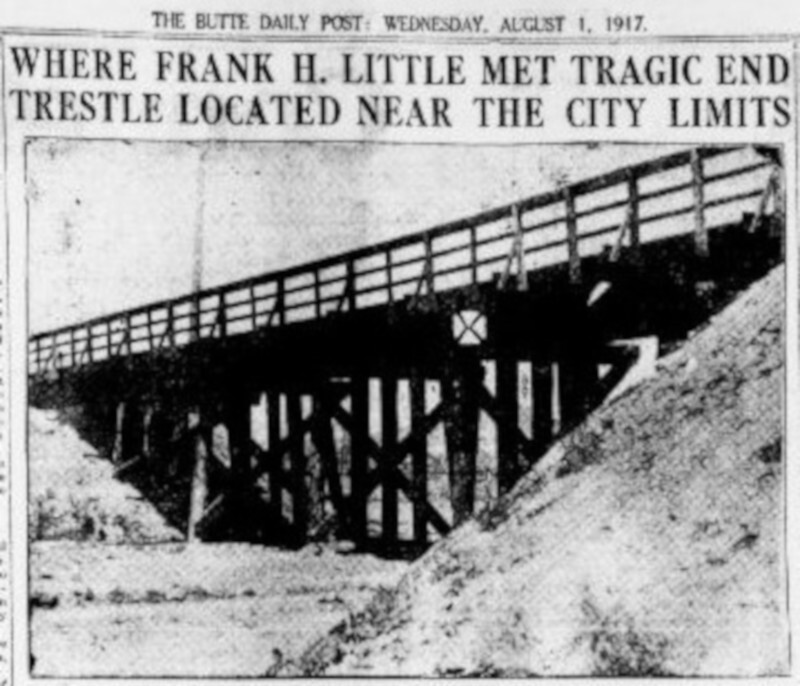
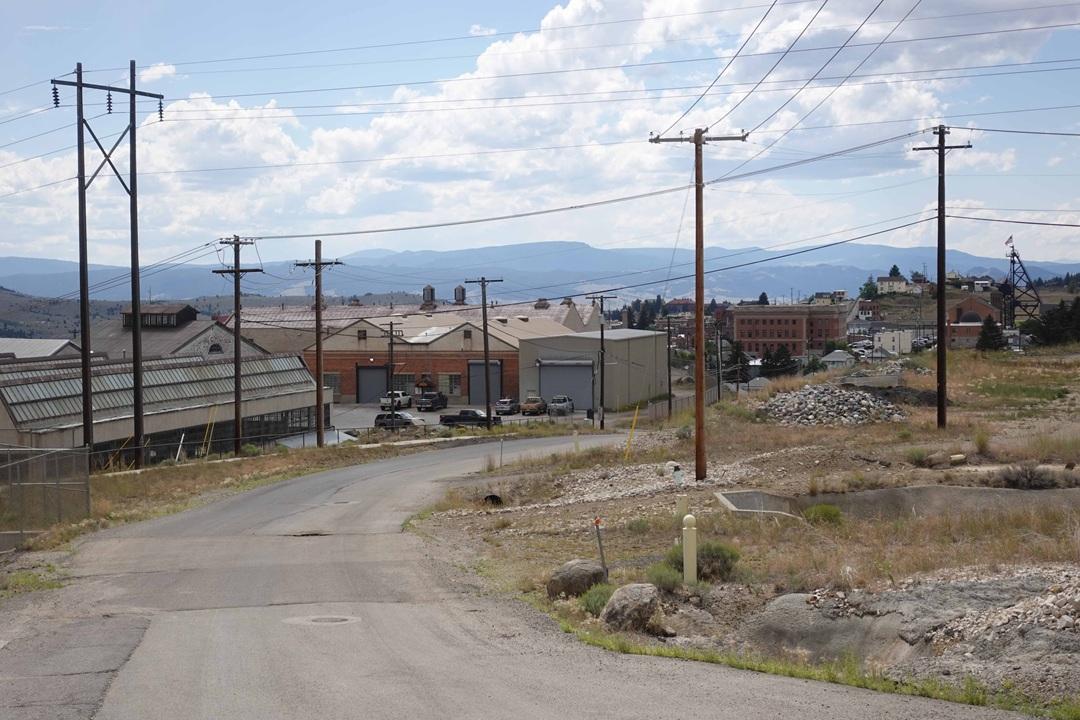
    <summary type="html"><![CDATA[<p><strong><em>After being beaten, Little was hanged from this train trestle.</em></strong></p><img src="https://storyofbutte.org/files/fullsize/e6559d9bda70863a088dd61e320e1453.jpg" alt="Milwaukee Railroad Trestle" /><br/><p>On the southwest edge of Butte in 1917, the Chicago, Milwaukee & St. Paul Railroad line crossed above a little dirt road on a wooden train trestle before heading out of town along Silver Bow Creek. That trestle was the final destination for Frank Little’s kidnappers in the early morning of August 1, 1917.</p><p>The Milwaukee Railroad line and trestle are now gone. In 1917, however, the Milwaukee was the newest of the West’s transcontinental railroads. It was also one of the longest electrified train lines in the world. Its electrical power was supplied in part by the Montana Power Company, a subsidiary of the Anaconda Company that John D. Ryan, Anaconda’s president, had started. </p><p>Shortly after Little’s kidnappers sped away from the boarding house in Uptown Butte, they stopped the car. They took Little out and tied him to the bumper. Then they dragged him through the streets, scraping off his kneecaps.</p><p>When the kidnappers arrived at the trestle, they parked underneath it and put Little on top of the car. They put a rope around Little’s neck and drove off, leaving the noose to tighten as Little dangled in the air. Little was probably unconscious, but not dead. He died of asphyxiation.</p><p>Hours later, a man named Charles Holmes was taking his regular route to work, which took him from a neighborhood south of the tracks to Alabama Street. Holmes walked north, crossing the County Road (now Centennial Avenue). Then he passed the Centennial Brewery on his left. The Centennial Brewery site is now a complex of industrial buildings at 701 Centennial Avenue. From the south end of Alabama Street, this complex is to the south and slightly to the west. </p><p>On a normal day, Holmes would have then passed under the Milwaukee trestle and over the Butte, Anaconda & Pacific Railroad tracks before reaching the south end of Alabama Street. But as he approached the Milwaukee trestle, he saw a dead body hanging from it. He headed home to notify the police.</p><p>The police arrived and cut Little down from the trestle. He was still warm. He had clearly been beaten before he was killed. And there was a note jabbed into his thigh. Written on a 6x10 inch placard in red crayon it said: “Others take notice. First and last warning.” Below that were the numbers 3-7-77, the traditional warning of the nineteenth-century vigilantes. At the bottom of the note was a series of letters, probably representing the names of Butte’s strike leaders. The first letter was L, for Little presumably. It had been circled, as if to show he had been crossed off the list as a problem.</p><p>Within hours, news spread through Butte that Frank Little had been murdered. </p><p><em><strong><a href="https://storyofbutte.org/items/show/3418">For more (including 3 images&#32;&amp;&#32;1 audio file) view the original article</a></strong></em></p>]]></summary>
    <published>2022-07-18T23:15:21+00:00</published>
    <updated>2026-04-17T19:58:08+00:00</updated>
    <link rel="alternate" type="text/html" href="https://storyofbutte.org/items/show/3418"/>
    <id>https://storyofbutte.org/items/show/3418</id>
    <author>
      <name>Leif Fredrickson</name>
    </author>
  </entry>
  <entry>
    <title type="html"><![CDATA[Frank Little Tour: Nora Byrne&#039;s Boarding House: Site of Frank Little&#039;s Kidnapping]]></title>
    <summary type="html"><![CDATA[<p><strong><em>Six masked men dragged Frank Little out of this boarding house at 3 a.m. on August 1, 1917, and drove away in a black Cadillac.</em></strong></p><img src="https://storyofbutte.org/files/fullsize/66338ac241fbbf9eb955aa2cc537dc82.jpg" alt="North Wyoming Street" /><br/><p>The large Butte Brewing Company took up much of the 200 block of North Wyoming. Wedged between the Brewing Company and the Finlander Hall was a residential flat and a boarding house. The boarding house was where Frank Little stayed in Butte, and where he spent his last night on earth.</p><p>The boarding house was owned by Nora Byrne, an immigrant from Ireland. She was a widowed mother, and boarding houses were one of the few businesses available at the time to women who needed to support themselves and their families. </p><p>When Little arrived, Byrne set him up in a room near the front entrance due to his broken ankle. Little returned to his room to sleep and write letters throughout his stay in Butte. On his third day in town, he returned to his room to find an envelope waiting for him. Inside was a note reading: “This is the first warning. Beware. 3-7-77.” </p><p>The numbers 3-7-77 were the calling card of the nineteenth-century Montana vigilantes. The specific meaning of the numbers is much debated today, but there is no question that they threatened death. Little showed the note to a fellow union organizer, then shrugged, tore it up, and went on with his business in town for the next ten days.</p><p>On July 31, in broad daylight, some unidentified men visited Nora Byrne’s boarding house. They asked about the new person (Frank Little) staying there. Later that evening, as Frank was returning to the boarding house, a barber stopped him outside the O’Brien Saloon on the corner of Wyoming and Copper Streets. The barber told Little that a lynching party was being formed, and he urged Little to leave town. But Little made no plans to leave. He returned to the boarding house, stripped down to his underwear, put his crutches away, and went to bed.</p><p>At 3 am that night, now August 1, a black Cadillac pulled up in front of the boarding house and six men in masks jumped out. Bearing pistols, they woke up Nora Byrne. They told her they were “officers,” and said they were looking for a man named Frank Little. She directed them to Little’s door, which they smashed open. The men dragged Frank out of bed and out of the boarding house, stuffed him in the car, and sped north on Wyoming Street, into the dark.</p><p>(Just a half block west on Quartz Street there is a memorial to Frank Little’s kidnapping. The kidnapping getaway route, however, does not seem to have been on Quartz Street).</p><p><em><strong><a href="https://storyofbutte.org/items/show/3417">For more (including 3 images) view the original article</a></strong></em></p>]]></summary>
    <published>2022-07-18T22:57:52+00:00</published>
    <updated>2026-04-17T19:58:08+00:00</updated>
    <link rel="alternate" type="text/html" href="https://storyofbutte.org/items/show/3417"/>
    <id>https://storyofbutte.org/items/show/3417</id>
    <author>
      <name>Leif Fredrickson</name>
    </author>
  </entry>
  <entry>
    <title type="html"><![CDATA[Frank Little Tour: Finlander Hall: Strike Leaders, and Frank Little, Held Meetings Here in 1917]]></title>
    <summary type="html"><![CDATA[<p><strong><em>Little argued for a more aggressive approach by striking miners.</em></strong></p><img src="https://storyofbutte.org/files/fullsize/9dcaead1b4ce3d5174830d7263d88a05.jpg" alt="Finlander Hall and Steel Block" /><br/><p>It was in this modest, two-story brick building that Butte’s union leaders, and Frank Little, hashed out strike strategy. The building was known as the Finlander Hall (or Finnish Hall). The original address was 318 North Wyoming, but the building was demolished in 1941, leaving only this parking lot. For 40 years before that, however, it served Butte’s Finnish community, as well as some of Butte’s radical labor and socialist organizations. </p><p>The Finlander Hall’s uses changed over time. Butte’s Finns built the hall in 1901. Initially, the purpose was primarily religious and social. It was their church and a place to host weddings, holiday events, and other celebrations. When the hall was built, Butte’s Finnish population was small. But after 1910, it grew rapidly. Finns were soon one of the largest ethnicities in the city, with an enclave (Finn Town) centered a few blocks southeast of here. </p><p>While Butte’s Irish were deeply divided between conservative and radical unionists, Finns were exceptionally open to left-wing politics. The Hall hosted union meetings early on, and by the early 1910s it was regularly hosting Socialist Party events. After 1914, Finlander Hall became associated with Butte’s growing IWW membership. When a left-wing union movement emerged in 1917, the Finlander was a natural fit for a meeting hall.</p><p>Butte’s new miners’ union was officially called the Metal Mine Workers’ Union (MMWU). Some MMWU members were also IWW members, but most were not, and the new union turned down  overtures to become a local of the IWW. Still, the strike leaders greeted Frank Little as an ally and included him in their meetings at the Finlander Hall. </p><p>By the time Little had joined them, the MMWU faced a tremendous uphill battle. Long strikes were grueling for workers and their families. And workers faced intense pressure from those who argued the strike was undermining America’s war efforts. These pressures, as well as the promise of better contracts, were already beginning to lure some skilled tradesmen back to the job in July of 1917.</p><p>Little argued, in closed door Finlander meetings, for a more aggressive approach. He suggested picketing mine entrances and packing protesters along the Anaconda Road (the main road that went up to the mines on the northeast side of the parking lot). But Butte’s strike leadership rejected that idea. They feared pickets and protests would be used as a pretext for violence by the Anaconda Company. And if chaos erupted, public opinion could turn against the union. </p><p>Violence, however, was already in the air. Private agents hired by the Company roamed the city. Some had even infiltrated the union and sat in on meetings at the Finlander. There were rumors that the police chief, Company gunmen, and government officials were hatching some kind of plan at the Finlen Hotel (a block and a half south). Frank Little, meanwhile, had already received direct death threats. </p><p><em><strong><a href="https://storyofbutte.org/items/show/3416">For more (including 2 audio files) view the original article</a></strong></em></p>]]></summary>
    <published>2022-07-18T22:43:09+00:00</published>
    <updated>2026-04-17T19:58:08+00:00</updated>
    <link rel="alternate" type="text/html" href="https://storyofbutte.org/items/show/3416"/>
    <id>https://storyofbutte.org/items/show/3416</id>
    <author>
      <name>Leif Fredrickson</name>
    </author>
  </entry>
  <entry>
    <title type="html"><![CDATA[Frank Little Tour: View of Columbia Gardens Location: Site of Frank Little&#039;s Most Famous Speech]]></title>
    <summary type="html"><![CDATA[<p><strong><em>The speech, given at the Columbia Gardens baseball stadium to a crowd of 6,000, was castigated as treasonous and seditious, and garnered national press attention.</em></strong></p><img src="https://storyofbutte.org/files/fullsize/c998c93001441c6108a77c3855c76b66.jpg" alt="Post Card of Columbia Gardens" /><br/><p>On July 18, 1917, Frank Little stepped off the train at the Northern Pacific Station about a mile to the south of here. He slowly made his way up to his lodging on North Wyoming Street near here. While Butte had been on strike, Little had been organizing for the IWW in Arizona’s copper mines. While there, he’d been in a car crash that broke his ankle, necessitating a cast and crutches. On top of that, he was suffering from a hernia. </p><p>Little was exhausted, in pain – and in danger. He had narrowly escaped being kidnapped and dropped in the southwestern desert by anti-labor vigilantes. That had been the fate of 1,200 other miners and organizers from Bisbee, Arizona, in one of the most notorious cases of union repression in history. It wouldn’t have been the first time he was kidnapped. In 1912, Little was abducted and beaten while organizing in Minnesota. </p><p>But the IWW had asked him to come to Butte. So he did. And he went to work right away. First up on the agenda was a rally at Columbia Gardens, where Little was scheduled to speak along with other labor organizers.</p><p>Columbia Gardens was a huge amusement park. The Copper King William A. Clark established the park in 1899, perhaps to curry favor with voters and unions. Unlike the Silver Bow Club, the Columbia Gardens was for everyone. </p><p>The park was located three and a half miles southeast of here, at the base of the mountains. Later in the twentieth century, the Continental Pit swallowed the park’s location. The excavated terraces at the far eastern side of Butte, visible from here, are approximately the location of the old Columbia Gardens. </p><p>Among other things, the Columbia Gardens had a baseball stadium. It was there that Frank Little gave what was probably the most famous speech of his life. Before a packed crowd of 6,000, Little lambasted greedy mine owners and called for all workers to join the IWW’s One Big Union. Little also lashed out against the war. His position was even controversial within the IWW, who feared invoking backlash by criticizing the war. But Little hated the war, which he saw as an extension of capitalist violence. And, in his most incendiary talking point, he castigated soldiers who took up arms against striking works as “federal thugs” and “scabs in uniform.”</p><p>The press the following day was awash in coverage of Little’s speech. Newspapers across Montana (many under the influence of the Anaconda Company) railed against Little’s “treasonous” and “seditious” speech. The national press picked up on it, too, given the stakes of Butte’s strike for the war. </p><p><em><strong><a href="https://storyofbutte.org/items/show/3415">For more view the original article</a></strong></em></p>]]></summary>
    <published>2022-07-18T22:29:14+00:00</published>
    <updated>2026-04-17T19:58:08+00:00</updated>
    <link rel="alternate" type="text/html" href="https://storyofbutte.org/items/show/3415"/>
    <id>https://storyofbutte.org/items/show/3415</id>
    <author>
      <name>Leif Fredrickson</name>
    </author>
  </entry>
  <entry>
    <title type="html"><![CDATA[Frank Little Tour: Granite Mountain Memorial: 168 Men Died in 1917 Fire]]></title>
    <summary type="html"><![CDATA[<p><strong><em>The disaster exacerbated tensions between miners and the Anaconda Company.</em></strong></p><img src="https://storyofbutte.org/files/fullsize/06cc7670f8c40a3681cc77d33e670c45.jpg" alt="Fire at the Speculator Mine" /><br/><p>Since the Butte Miners Union’s demise in 1914, tensions between miners and mine owners had only grown more severe. War exacerbated this, first by ramping up copper production, which yielded big profits for mine owners but only minimal benefits for mine workers. And second by threatening to draft workers into a war they believed they had no interest in.</p><p>In the midst of these tensions, an unprecedented tragedy hit Butte. On June 8, a fire broke out in the Granite Mountain Mine. A miner’s headlamp accidentally ignited oil cloth sheathing on a long cable in a shaft. Flames quickly shot up the mine shaft, igniting timber supports. The fire spread through the mine and into an adjoining mine, the Speculator. </p><p>The fire pumped smoke and toxic gases through the vast network of tunnels in Butte’s mines. Miners trying to escape had to navigate a maze of dark, smoke-filled tunnels. In addition, in flagrant violation of safety laws, the mine companies had walled off some of the tunnels. Later, dead men were found with their fingertips ground to the bone from clawing against the closed walls trying to escape.</p><p>Miners on the surface launched heroic rescue efforts. But it was impossible to reach many of the men locked thousands of feet in the depths of the mountain. Some rescuers died trying. In the end, 168 miners lost their lives. It was, and remains, the worst hard-rock mining disaster in U.S. history.</p><p>The mine disaster catalyzed a spontaneous strike in one Butte mine that eventually spread to all of the other mines. Other trades associated with the mines also struck. Butte’s miners organized a new union. They demanded safety reforms, better pay, and above all, an end to the “rustling card” system that allowed the Anaconda Company to ban workers who threatened its power. But Anaconda refused to end the system. So the strike went on, paralyzing the greatest copper mines on earth.</p><p>Given the strategic importance of copper to the war, Butte’s strike quickly gained national attention. Labor organizers, mine owners, consumers, and the federal government all recognized it as a strike of potentially immense consequences. The city, and the nation, were on edge. </p><p><em><strong><a href="https://storyofbutte.org/items/show/3414">For more (including 2 audio files) view the original article</a></strong></em></p>]]></summary>
    <published>2022-07-18T22:16:53+00:00</published>
    <updated>2026-04-17T19:58:08+00:00</updated>
    <link rel="alternate" type="text/html" href="https://storyofbutte.org/items/show/3414"/>
    <id>https://storyofbutte.org/items/show/3414</id>
    <author>
      <name>Leif Fredrickson</name>
    </author>
  </entry>
  <entry>
    <title type="html"><![CDATA[Frank Little Tour: Federal Building: Site of 1917 Clash Between Antiwar Protesters and Police]]></title>
    <summary type="html"><![CDATA[<p><strong><em>Union organizers saw suppression of the antiwar demonstration as an attack on labor organizing. The IWW sent one of its most experienced organizers to Butte: Frank Little.</em></strong></p><img src="https://storyofbutte.org/files/fullsize/954a05b7fe80498bb412caec4dddbc55.jpg" alt="Federal Building" /><br/><p>Butte’s history is replete with tumultuous years, but no year was more tumultuous than 1917. And it was here, in front of the Federal Building, that conflicts over labor and war first bubbled over into violence on a large scale in that year. The next few months would see the city descend into sorrow, anger, and fear.</p><p>Workers completed Butte’s Federal Building in 1904. The building’s Beaux Arts style is evident in its use of light stone, its symmetrical façade, and its monumental massing. These architectural elements were strongly associated with the then-popular City Beautiful movement, an urban planning philosophy that sought to bring order and beauty to cities at a time of massive immigration, rapid population growth, and intense industrialization. </p><p>Butte exemplified these urban changes. It was famous for its industrial riches, but also infamous for its industrial pollution and filth. And it grew rapidly to become one of the biggest cities in the Northwest in the early 1900s. Most of that growth came from immigrants. The city was exceptionally diverse. There were Bohemians, Turks, Chinese, Cornish, Finns, and dozens of other nationalities and ethnicities. One ethnicity was dominant, however: the Irish. In 1900, Butte had the highest proportion of Irish-Americans of any city in the nation.</p><p>For immigrants who hoped to settle permanently in the U.S., the Federal Building was an important place. It was here, in finely-crafted courtrooms, that thousands of naturalization ceremonies took place. </p><p>When the United States entered World War I on April 2, 1917, the Federal Building also became the location for draft registration. </p><p>Many of Butte’s immigrant groups, however, were hardly enthusiastic about the war. In particular, people from Ireland and Finland had no desire to fight in a war alongside their colonial oppressors, England and Russia. On June 5, Irish nationalists organized a thousand-strong antiwar and antidraft demonstration in front of the Federal Building. The protest soon turned into a large clash with the police. Yet again, the governor imposed martial law on the city. </p><p>The antiwar organizers were also involved in a simultaneous effort to reconstitute a miners’ union. Seeing the suppression of the antiwar demonstration as a deliberate attack on labor organizing, Butte unionists sent out calls for help to other unionists, including the Industrial Workers of the World. The IWW, seeing Butte’s situation as vital to its cause, chose to send in one of its most experienced organizers: Frank Little.</p><p><em><strong><a href="https://storyofbutte.org/items/show/3413">For more (including 1 audio file) view the original article</a></strong></em></p>]]></summary>
    <published>2022-07-18T22:03:04+00:00</published>
    <updated>2026-04-17T19:58:08+00:00</updated>
    <link rel="alternate" type="text/html" href="https://storyofbutte.org/items/show/3413"/>
    <id>https://storyofbutte.org/items/show/3413</id>
    <author>
      <name>Leif Fredrickson</name>
    </author>
  </entry>
  <entry>
    <title type="html"><![CDATA[Frank Little Tour: Butte Miners Union Hall: The BMU was an effective advocate for Butte miners in the late 1800s]]></title>
    <summary type="html"><![CDATA[<p><strong><em>The union hall, built in 1885, was blown up in 1914 during violence among competing union factions.</em></strong></p><img src="https://storyofbutte.org/files/fullsize/097befc33ffd295e30b476e75a224137.jpg" alt="Miners Union Hall" /><br/><p>Along with the “Richest Hill on Earth,” Butte also garnered the label of the “Gibraltar of Unionism.” Butte was indeed a fortress of solidarity. But as it turned out, that fortress could be blown up, just as much as the hard granite encasing Butte’s rich copper deposits.</p><p>In the late 1800s, Butte was a preeminent pro-labor town. The Butte Miners Union (BMU) was one of the largest local unions in the United States. The union’s first meeting hall, built here in 1881, collapsed. But by 1885, the union had raised funds to construct another building. This new, two-story, brick building stood strong for decades, right alongside the BMU.</p><p>The BMU’s strength, coupled with warring Copper Kings, gave miners a strong hand in late-nineteenth century Butte. Mine owners didn’t question the BMU’s legitimacy, and the union secured high wages for its miners. </p><p>Miners elsewhere in the West were not so lucky, and they turned to the BMU for help. In 1893, after a series of violent strikes in the Idaho silver mines, miners across the West met in Butte at the Miners Union Hall to create the Western Federation of Miners (WFM), an organization that could coordinate strike support across the West. The BMU became Local #1 of the WFM.</p><p>In the early 1900s, striking miners faced intense violence from state authorities and mining companies’ hired guns. This violence prompted some WFM organizers to create an even broader federation of workers in 1905: the Industrial Workers of the World (IWW). Unlike other labor federations, the IWW sought to organize all workers, regardless of occupation, skill level, race, gender, or nationality. Moreover, the ultimate goal of the IWW was the abolition of capitalism. It was a radical vision that attracted committed, but idealistic, activists like Frank Little, who at the time was a WFM organizer working in Arizona.</p><p>Meanwhile in Butte, the Anaconda Company had consolidated mine ownership, thereby undermining the BMU’s power. Some miners found hope in the emerging radicalism of the IWW. But the BMU’s leadership was more conservative. In 1912, the Company instituted the “rustling card” system that allowed the Company to blacklist radical mine workers. BMU’s leadership capitulated. Internal strife grew in the union, reaching a breaking point two years later. </p><p>On June 13, 1914, radical and dissatisfied BMU members attacked union leaders during the Miners Union Day parade. A riot of competing union factions broke out. Ten days later, an angry crowd gathered outside the Miners Union Hall where the BMU leadership was meeting. Anger led to violence. Two men were shot and killed. Later that night a dynamite blast ripped through the hall, reducing the walls to rubble. </p><p>After more clashes and bombings in the summer, the governor declared martial law and sent in the National Guard. With the BMU and its meeting hall in ruins, the Anaconda Company announced it would no longer recognize a miners’ union. The once mighty BMU had fallen.</p><p><em><strong><a href="https://storyofbutte.org/items/show/3412">For more (including 2 images) view the original article</a></strong></em></p>]]></summary>
    <published>2022-07-18T21:44:20+00:00</published>
    <updated>2026-04-17T19:58:08+00:00</updated>
    <link rel="alternate" type="text/html" href="https://storyofbutte.org/items/show/3412"/>
    <id>https://storyofbutte.org/items/show/3412</id>
    <author>
      <name>Leif Fredrickson</name>
    </author>
  </entry>
  <entry>
    <title type="html"><![CDATA[Frank Little Tour: Silver Bow Club: Meeting Place of Butte&#039;s Wealthy Elite]]></title>
    <summary type="html"><![CDATA[<p><strong><em>In the early 1900s the opulent Silver Bow Club was emblematic of the difference between the classes in Butte, which lead to the rise of radical labor movements.</em></strong></p><img src="https://storyofbutte.org/files/fullsize/054969572a15e61dcda74e86d1ee82a9.jpg" alt="Silver Bow Club" /><br/><p>In the first two decades of the 1900s, class conflict afflicted Butte as never before. Butte may have been the “Richest Hill on Earth,” but the riches of its copper mines were not shared equally. Miners got a wage to survive on. Mine owners, meanwhile, profited extravagantly, as did a small set of professionals and businessmen associated with the copper business. </p><p>The Silver Bow Club was where this affluent elite met. The Club met in a few different places in Butte before settling here, where it built an opulent, four-story building. There, in the glow of fireplaces and copper chandeliers, members rubbed shoulders with corporate titans like banker J.P. Morgan.  </p><p>Butte had its own turn-of-the-century titans: the Copper Kings. These rival copper barons were F. Augustus Heinze, William Clark (who started the Silver Bow Club in 1882), and Marcus Daly, the head of the Anaconda Company. For years, the Copper Kings fought bitterly for control of Butte’s copper mines. But by the time this new Silver Bow Club building was completed in 1907, the Anaconda Company had come out on top. </p><p>Anaconda’s victory shifted the balance of power between labor and capital in Butte. Competition forced the Copper Kings to placate the labor unions, lest workers drop their tools and go to work for a rival company. But Anaconda’s victory eventually made it the overwhelmingly dominant employer, not just in Butte, but in the whole state. This gave the Company (as Montanans called it) immense power over its workers and the state as a whole. In 1903, it temporarily shut down its mines and smelters, inflicting devastating economic pain on miners and the state economy. After that, the threat of a shutdown loomed large in the minds of any challengers to its power.</p><p>John D. Ryan, an ambitious executive, guided Anaconda’s dramatic rise to power in the early twentieth century. Marcus Daly had died in 1900 and the Company came under the control of Eastern capitalists. Ryan’s success resulted in his promotion to president of the Company in 1910. The Silver Bow Club celebrated the promotion in what the Butte Daily Post called “one of the most notable banquets in the history of Butte.” The governor and lieutenant governor attended. </p><p>But Butte miners weren’t celebrating the Company’s increasing power. Their discontent would open the door to more radical labor organizing approaches, and would bring Frank Little, one of the most radical labor organizers of the era, to Butte.  </p><p><em><strong><a href="https://storyofbutte.org/items/show/3411">For more (including 2 images) view the original article</a></strong></em></p>]]></summary>
    <published>2022-07-17T23:45:39+00:00</published>
    <updated>2026-04-17T19:58:08+00:00</updated>
    <link rel="alternate" type="text/html" href="https://storyofbutte.org/items/show/3411"/>
    <id>https://storyofbutte.org/items/show/3411</id>
    <author>
      <name>Leif Fredrickson</name>
    </author>
  </entry>
</feed>