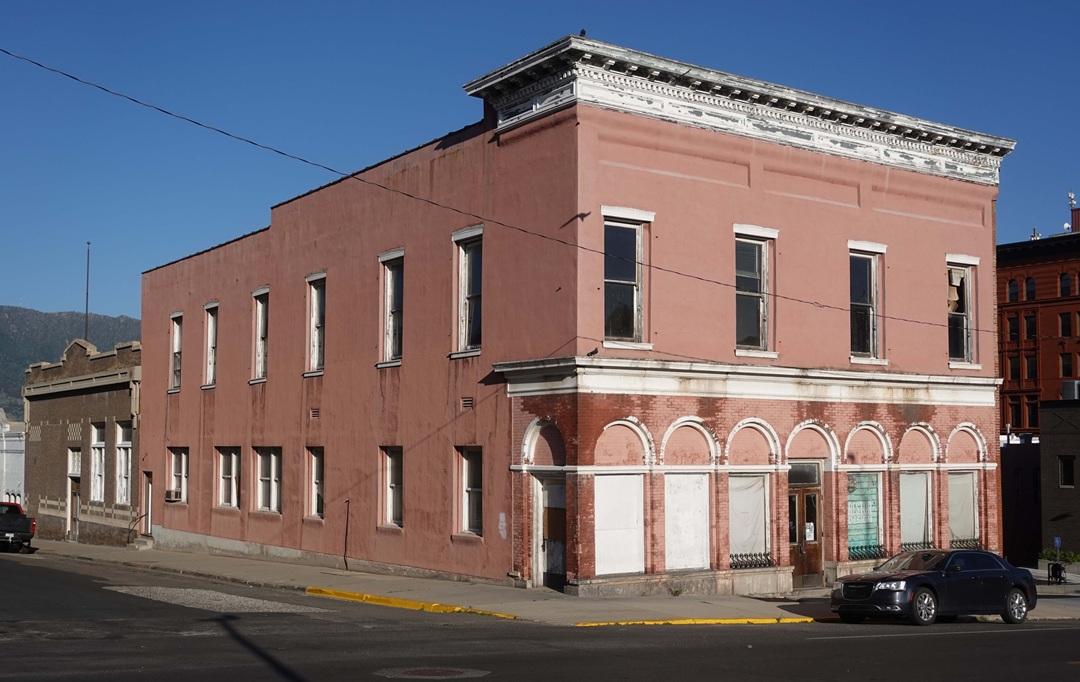
<?xml version="1.0" encoding="UTF-8"?>
<feed xmlns="http://www.w3.org/2005/Atom">
  <title type="text">Story of Butte</title>
  <updated>2026-04-17T19:58:11+00:00</updated>
  <generator uri="http://framework.zend.com" version="1.12.20">Zend_Feed_Writer</generator>
  <link rel="alternate" type="text/html" href="https://storyofbutte.org/"/>
  <link rel="self" type="application/atom+xml" href="https://storyofbutte.org/items/browse?output=rss2"/>
  <id>https://storyofbutte.org/</id>
  <author>
    <name>Story of Butte</name>
    <uri>https://storyofbutte.org</uri>
  </author>
  <link rel="hub" href="https://pubsubhubbub.appspot.com/"/>
  <entry>
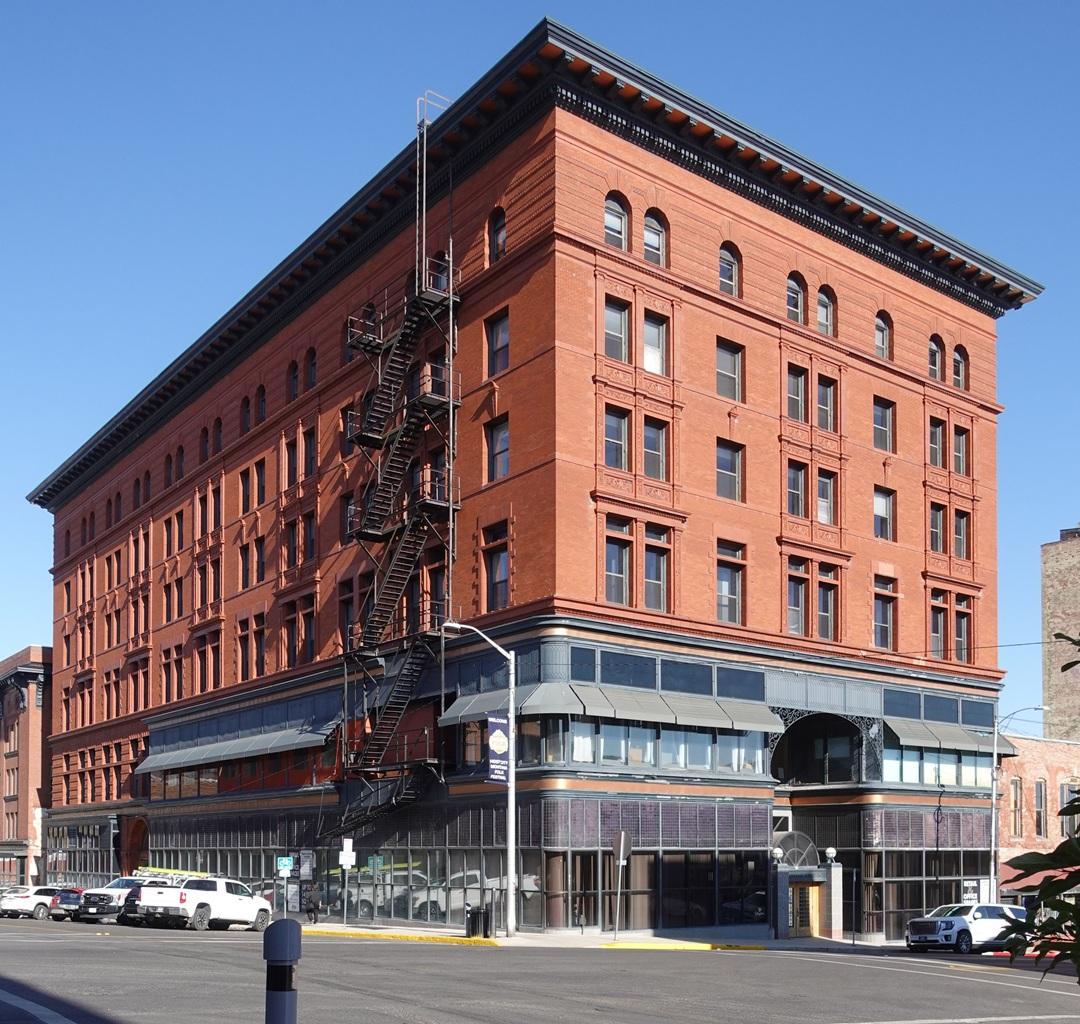
    <title type="html"><![CDATA[Hennessy Building]]></title>
    <summary type="html"><![CDATA[<p><strong><em>The Hennessy Building gets its name from Daniel J. Hennessy, a close associate of Marcus Daly.  Hennessy was born in New Brunswick, Canada, in 1854 and, while still a teenager, went to work in a local dry goods store. </em></strong></p><img src="https://storyofbutte.org/files/fullsize/5e210a237581a360fdc5236ad09d6903.jpg" alt="Hennessy Building" /><br/><p>He left New Brunswick in 1879 and started making his way west. When he arrived in Butte, he went to work for the Butte branch of E.L. Bonner and Company, the Missoula-based mercantile store. In the late 1880s, as the Clark-Daly feud got underway, Daly grew angry with the owners of the Bonner company, so he financed Hennessy to open the Hennessy Mercantile Company in 1886. That relationship continued when the company decided to build a new store at the southeast corner of Granite and Main in Uptown Butte. The building was owned by ACM and leased to Hennessy’s company for the new mercantile.</p><p>Excavation of the foundations began in September 1897, and construction was to continue that fall under the superintendence of Frank Jones, chief carpenter for the Anaconda company in Anaconda. The Anaconda firm of Smith and Black was the architect. Construction halted in November, however, for unknown reasons. Speculation included that the owners were still trying to buy the building to the south along Main Street, so the new building could be larger, and that the project was having trouble getting the order for structural steel filled in Chicago.</p><p>Hennessy announced in March 1898 that construction of the new building would resume, now under supervision of a new architect, Frederick Kees of Minneapolis. Kees had designed several prominent buildings in Minneapolis, including the City Hall and the Masonic Temple. The Gillette-Herzog Manufacturing Company, a steel fabricator that built bridges in Minnesota and across the northern tier of states, including Montana, would be the contractor. The firm also built steel headframes, including those at the Diamond, Steward, and High Ore mines. Steel for the structure of the Hennessy Building filled thirty railroad cars, which arrived from Minneapolis in April 1898. Erecting the steel led to a minor bit of labor unrest, when Gillette-Herzog brought union iron workers from the east to work on the project, and Butte unions objected. The issue was resolved when the contractor agreed to hire Butte men to work on the ground, and the local unions agreed to allow skilled iron workers from the east to work above the ground. Another labor issue arose in Fall 1898, when the Plasterers Union had a complaint against the contractor. The superintendent of construction for the Hennessy Building issued an ultimatum from ACM (not the Hennessy Mercantile Company) that the men return to work.</p><p>The Hennessey Mercantile Company opened its new store on November 21, 1898. A newspaper article in early December 1898 praised the new building’s architecture and lauded the colossal nature of the store itself, which occupied the basement and the first three floors. Regarding the upper three floors, the article merely stated that they would be rented for offices. Newspapers in subsequent years featured advertisements for doctors, dentists, lawyers, insurance agents, and other professionals who had offices in the Hennessy Building.</p><p>When Amalgamated Copper started consolidating Butte’s mining industry in 1899 by acquiring ACM and other mining companies, it also acquired a large interest in the Hennessy Mercantile Company. Nevertheless, little was written in newspapers about the corporate affiliations of occupants of the top floor of the Hennessy Building. Among those occupants were engineer John Gillie and attorney William Scallon (soon to be president of ACM), who moved his office from the Tuttle Block to the sixth floor of the Hennessy Building when it was completed. . When attorney A.J. Shores moved to Butte to work for ACM in 1900, he established his office on the top floor. In the early years of the twentieth century, as the feud between F. Augustus Heinze and Amalgamated entered full bloom, Heinze sympathizers often used having an office in the Hennessy Building as a tarnish against those charged with being affiliated with Amalgamated.</p><p>D.J. Hennessy purchased Amalgamated’s interest in his business in 1904 but Amalgamated continued to own the building. In 1906, Hennessy built (and owned) the Hennessy Annex immediately east of the Hennessy Building. It was designed by architect W.A. O’Brien. Hennessy also built his mansion at the corner of Park and Excelsior in 1906. He died in January 1908. The Hennessy store continued to be a commercial fixture in Uptown Butte into the 1980s. When ARCO closed mining operations in Butte in 1982, Montana Power occupied the building. </p><p><em><strong><a href="https://storyofbutte.org/items/show/3561">For more (including 6 images) view the original article</a></strong></em></p>]]></summary>
    <published>2025-11-14T22:31:08+00:00</published>
    <updated>2026-04-17T19:58:11+00:00</updated>
    <link rel="alternate" type="text/html" href="https://storyofbutte.org/items/show/3561"/>
    <id>https://storyofbutte.org/items/show/3561</id>
    <author>
      <name>Fred Quivik</name>
    </author>
  </entry>
  <entry>
    <title type="html"><![CDATA[Tuttle Block]]></title>
    <summary type="html"><![CDATA[<p><strong><em>Shelley Tuttle was born in Michigan in 1852 and arrived in Butte in 1877. He   worked for the Alice Mining Company for two years. Tuttle then started working as a contractor, building the concentrator at the Montana smelter (original name of the Boston & Montana’s upper works) in Meaderville and the hoisting works of at the Moulton mine in Walkerville. </em></strong></p><img src="https://storyofbutte.org/files/fullsize/1234f2a0eb4fc17ae2c78bb7e147ea2c.jpg" alt="Tuttle Block, 300-304 N. Main" /><br/><p>He and a partner purchased the Lexington Foundry in Butte in 1882. It was located on East Park, just east of Arizona Street. At some point along the way, Tuttle and Marcus Daly became close associates, perhaps through their shared passion for racehorses. In September 1889, crews began excavating foundations at the southeast corner of the Anaconda townsite for a new foundry complex, built by Tuttle with backing from Daly. In early 1890, as portions of the foundry were completed and as a machine shop and boiler works were being added, Tuttle and Daly, along with Dennis F. Hallahan, incorporated with Tuttle Manufacturing and Supply Company. The new company purchased the Anaconda Commercial Company and made plans to open a branch store in Missoula. It also bought the Butte Trading Company, which had been incorporated in 1888 by Daly, Haggin, and other central figures in the Anaconda enterprise to sell mining supplies.</p><p>Tuttle built the Tuttle Block, on the northeast corner of Quartz and Main, in 1892. The two-story brick building housed a storefront for the Tuttle Manufacturing and Supply Company on the first floor and offices to rent on the second floor. The store sold a wide range of supplies for mining, from hoisting engines and wire rope to batteries and lubricating oils. It was also an agent for other companies that made such equipment as rock drills and pumps. One of the early renters of an office on the second floor was Dr. J.A. Tremblay. In 1893, the Anaconda Mining Company, which had been holding stockholders’ meetings across the street in the Chambers Block, began holding those meetings on the second floor of the Tuttle Block. The company reorganized to form a new corporation, the Anaconda Copper Mining Company, in 1895. The principals of the Anaconda Mining Company began laying the groundwork for that transaction during meetings in the Tuttle Block in 1894, and they met there in 1895 when they agreed to transfer all of Anaconda Mining’s property to the new Anaconda Copper Mining Company.</p><p>In 1896, Tuttle sold his share of the Tuttle Manufacturing and Supply Company, and two new Daly associates joined the board of trustees. The trustees then agreed to sell the company to the Anaconda Copper Mining Company. ACM then changed the name of its stores in Butte, Anaconda, and Missoula to the Hardware Department of ACM, and its foundry and manufacturing plant in Anaconda became the Foundry Department of ACM.</p><p>ACM acquired the Tuttle Block in 1911, shortly after ownership and operations of all the Amalgamated subsidiaries were consolidated into the hands of ACM. ACM intended to add a third floor and to use the two upper floors as the general offices of the company, functions that had been housed in Anaconda. By 1911, Silver Bow County had been renting a large room on the second floor to use as a courtroom and some of smaller rooms as a jury room and sleeping rooms for jurors. Because of ACM’s plans, the county court had to move. The Anaconda Company continued to use the Tuttle Block as its general office until ARCO ceased mining in Butte.</p><p><em><strong><a href="https://storyofbutte.org/items/show/3560">For more (including 3 images) view the original article</a></strong></em></p>]]></summary>
    <published>2025-11-14T22:20:28+00:00</published>
    <updated>2026-04-17T19:58:11+00:00</updated>
    <link rel="alternate" type="text/html" href="https://storyofbutte.org/items/show/3560"/>
    <id>https://storyofbutte.org/items/show/3560</id>
    <author>
      <name>Fred Quivik</name>
    </author>
  </entry>
  <entry>
    <title type="html"><![CDATA[Chambers Block]]></title>
    <summary type="html"><![CDATA[<p><strong><em>The Chambers Block was built in 1881-1882 to house Hoge, Brownlee & Company, a bank owned by Marcus Daly and his associates. One of them was Robert C. Chambers, a close associate of George Hearst and best known as the superintendent of the Ontario mine in Park City, Utah. </em></strong></p><img src="https://storyofbutte.org/files/fullsize/3e63445f543d90ee8bfe902fe39600d8.jpg" alt="Chambers Block, 220-224 N. Main" /><br/><p>One of the most profitable bonanza silver mines in the American west, it was owned by the Ontario Silver Mining Company, of which George Hearst, James B. Haggin, and Lloyd Tevis were the principal owners. Born in Ohio in 1832, Chambers joined the California Gold Rush, arriving at Sacramento in 1850. He worked in California’s gold fields as a placer miner and in the mercantile business. In 1869, he sold his business and returned to mining, first in Nevada and then Utah, where he met George Hearst. Chambers traveled to Montana in 1871 to scout mining properties for Hearst. He returned to Utah, where Marcus Daly had recommended that Hearst acquire the Ontario mine. Chambers purchased the mine for Hearst in 1872, and Hearst made him superintendent. After Daly moved to Butte to develop the Alice mine on behalf of the Walker Brothers, he secretly wrote to Chambers, recommending that Hearst take an interest. That all came to pass in 1881, when Daly bought the Anaconda mine and enlisted Hearst, Haggin, and Tevis to invest in its development.</p><p>Chambers and Hearst travelled to Butte in July 1881 to help Daly start sinking the shaft of the Anaconda mine. Later that year, Chambers contracted with James Renshaw to build a two-story brick building at the southeast corner of Quartz and Main to house the bank, Hoge, Brownlee & Company. Daly, Hoge, Brownlee, Chambers, and F.E. Seargent were principles in the bank. Construction of the building began in late 1881 and was completed in early spring 1882. Counters and other bank fixtures arrived from San Francisco in March. Other renters in the Chambers Block in 1882 included surveyors Barker and Harper; F.R. McConnell, general western agent for the Union Pacific Railway, which had just inaugurated rail service to Butte; and Marcus Daly.</p><p>Although Chambers’ main job remained managing operations at the Ontario mine in Park City, he and his building in Butte continued to play roles in the development of the Anaconda mining enterprise. While Daly and his investors had bought and were developing the Anaconda and adjoining St. Lawrence mines, Chambers became nominal head of a group of investors, called the Chambers Syndicate, who started buying other mining claims higher on the Butte hill, including the Mountain Consolidated, Modoc, Green Mountain, and High Ore. Development of those properties, called the Syndicate group of mines, was managed by the Anaconda company, and by the late 1880s, the Syndicate mines were also sending ore to the Anaconda smelters.</p><p>When the Anaconda Mining Company incorporated in 1891 under the laws of Montana, it held its annual stockholders’ meetings in the Chambers Block in what was called the office of the company (rooms 1 and 3). Beginning in 1893, the Anaconda Mining Company held its stockholders’ meetings in the Tuttle Block, which had been built across Quartz Street in 1892. When the company reorganized as the Anaconda Copper Mining Company in 1895, it continued to use the Tuttle Block for meetings.</p><p>Meanwhile, the bank of Hoge, Brownlee & Company continued to occupy the corner storefront of the Chambers Block until it changed its name in early 1899 to Marcus Daly and Company. Owners of the bank were now Daly, J.B. Haggin, and Michael Donahoe, who was vice president and general manager of the Butte, Anaconda & Pacific Railway. After the bank hired William L. Moyer from Chicago in July 1899 to manage the business, the bank again changed its name to Daly, Donahoe and Moyer. Daly died in 1900, and early in 1901, a new company, Daly Bank and Trust incorporated, with W.W. Dixon (long-time attorney for Marcus Daly and the Anaconda enterprise) as president and John D. Ryan as vice president. Ryan became president of the bank in 1902, beginning his rise in the Anaconda world. The Daly Bank moved into the former State Savings Bank Building on the southwest corner of Park and Main in 1916 and changed its name to the Metals Bank and Trust Company in 1920. Since then, it has been known as the Metals Bank Building. After the Daly Bank moved, ACM acquired the Chambers Block and remodeled the first and second floors in 1917 to serve as ACM paymaster’s office.</p><p><em><strong><a href="https://storyofbutte.org/items/show/3559">For more (including 6 images) view the original article</a></strong></em></p>]]></summary>
    <published>2025-11-12T21:30:50+00:00</published>
    <updated>2026-04-17T19:58:11+00:00</updated>
    <link rel="alternate" type="text/html" href="https://storyofbutte.org/items/show/3559"/>
    <id>https://storyofbutte.org/items/show/3559</id>
    <author>
      <name>Fred Quivik</name>
    </author>
  </entry>
  <entry>
    <title type="html"><![CDATA[Marcus Daly Statue: Statue Pays Tribute to One of Butte&#039;s Three Copper Kings]]></title>
    <summary type="html"><![CDATA[<p><strong><em>Originally installed on a steep hill on Main Street in 1907, the statue was a traffic hazard and was moved to the Montana Tech Campus in 1941.</em></strong></p><img src="https://storyofbutte.org/files/fullsize/4d4b3b4dea781d53c3161166512d01af.jpg" alt="Marcus Daly Statue" /><br/><p>Marcus Daly, one of Butte’s three copper kings,  died November 12, 1900, at age 58. Within weeks, the Marcus Daly Memorial Association was organized with the primary goal of commissioning a monument. The group contracted internationally known sculptor Augustus St. Gaudens, the Irish-born designer of the US $20 gold piece, to craft a larger-than-life-size bronze statue of Daly.</p><p>The Association raised $25,000 in the first year, enough to cover St. Gaudens’ fee. Dozens of donations came in at $5, but the largest contributions came from the Daly Bank, then owned by Daly’s widow, at more than $8,000, and the Hennessey Mercantile, which donated more than $6,000. St. Gaudens had the first casting done by 1904, but it was destroyed in a fire in his New Hampshire studio. The second casting, by Gorham and Company in Rhode Island, was shipped to Butte for installation on Main Street in front of the Post Office, today’s Federal Building. The grand unveiling on September 2, 1907, came a month after St. Gaudens died. The Daly statue is his last significant work.</p><p>A massive $15,000 granite base was designed by New York architects and stone carvers John Carrere and Thomas Hastings. The granite was quarried at the Welch Quarry east of Homestake Pass and shipped to New York for carving. After St. Gaudens completed the statue of Daly it was shipped to Butte, but was stored in a warehouse for a year awaiting the completion of the base. Its final assembly in the summer of 1907 was done by Anaconda Company engineer Fred Green. </p><p>North Main Street has a steep decline, and the huge island in the middle of the road that held the Daly statue was a problem for vehicles, which tended to slide into the base. A local committee promoted the idea of moving the statue to the School of Mines campus, and Daly’s widow, Margaret, agreed. She donated $5,000 to the Butte Pioneer Club to pay for the move. </p><p>Despite a remarkable number of people who seem to remember the statue on Main Street as recently as the 1960s, the statue and its base were dismantled and moved to West Park Street on June 25, 1941. Mrs. Daly wanted to see the change accomplished before she died. She passed away just three weeks after the move. </p><p>The statue itself was loaded into the bed of a pick-up truck that hauled it up Park Street. The new location at the gateway to Montana Tech is still an island in the street, but the base is far smaller than the original on Main Street. </p><p><em><strong><a href="https://storyofbutte.org/items/show/3401">For more (including 2 images) view the original article</a></strong></em></p>]]></summary>
    <published>2022-07-01T17:19:26+00:00</published>
    <updated>2026-04-17T19:58:08+00:00</updated>
    <link rel="alternate" type="text/html" href="https://storyofbutte.org/items/show/3401"/>
    <id>https://storyofbutte.org/items/show/3401</id>
    <author>
      <name>Richard Gibson</name>
    </author>
  </entry>
</feed>