Filed Under Mining History

Smelting

Robert Peele’s 1916 Mining Engineering Handbook defines ore: “An ore is a metal-bearing mineral, or aggregate of such minerals, mixed with barren matter, called ‘gangue,’ and capable of being mined at a profit.”

The metal-bearing minerals in the Butte Hill include copper sulfides as well as the sulfides of other base metals, like zinc and lead. The copper sulfides are chemical compounds consisting of atoms of copper and sulfur as well as other elements, like iron and arsenic, and with names like chalcocite (Cu2S), bornite (Cu5FeS4), enargite (Cu3AsS4), and chalcopyrite (CuFeS2). To convert ore into metallic copper, those molecules of copper sulfide must be broken apart to yield pure copper and to dispose of the other elements. Doing that requires smelting, usually in furnaces to raise the temperature so that oxygen in the atmosphere can combine with the sulfur and other elements to liberate the copper.

Some of the first copper ores found in the Butte Hill were rich enough in copper and other metals that they could be shipped to distant smelters for treatment and still yield a profit, but miners knew that most of Butte’s ores would have to be smelted locally to be profitable. The Montana Copper Company built Butte’s first successful copper smelter in 1879. Within a few years, there were another half dozen copper smelters in Butte. Operators of each of these smelters recognized that they could be more profitable if they built concentrators to mechanically separate much of the gangue from the metal-bearing minerals before sending the concentrates to the smelter. Through the end of the nineteenth century and into the twentieth, Butte was a major smelting center.

When Marcus Daly launched his Anaconda Company, he recognized that water, needed for concentrating, was scarce in Butte, and that Butte’s valley location had a limited capacity for the smoke that smelting produced. He decided to build a smelter at his new town of Anaconda twenty-six miles west of Butte along Warm Springs Creek. The first Anaconda smelter went into operation in 1884 with a capacity five times greater than any of the Butte smelters. He built another smelter at Anaconda in 1889. Both of those smelters were replaced in 1902 by the more-modern Washoe Reduction Works. Gradually, the Butte smelters closed, with the last one closing in the 1920s. Ore was sent to Anaconda for smelting, where that smelter had grown to giant proportions. Consequently, Butte came to be known as the “Mining City” and Anaconda as the “Smelter City.”

Almost all traces of Butte’s once prominent smelting industry have been wiped from the landscape. The one exception is the “slag canyon” through which Silver Bow Creek passes just west of Montana Street, where the Butte Reduction Works once stood. Smelters produce two sets of waste products: smoke, which carries sulfur dioxide, arsenic, flue dust, etc.; and slag, which is a molten waste from the smelting furnaces carrying mostly silica and iron but also other metals. When the Butte Reduction Works was operating, it had to control the flow of Silver Bow Creek through its property and also address the complaints of downstream farmers who claimed that tailings from the concentrator were damaging their lands and crops along the stream. The Butte Reduction Works used molten slag, poured into formwork, to build the walls that form the canyon, and also to build slag walls visible further west to impound the tailings and prevent them from flowing downstream. The tailings were reprocessed in the late 1910s, leaving the slag walls as the only physical remains of Butte’s once important smelting industry.

Images

Slag Canyon
Slag Canyon Slag canyon along Silver Bow Creek just west of South Montana Street. This is the last surviving physical feature of Butte’s prominent smelting industry. Source: Photo by Fred Quivik, July 2024.
Boston & Montana’s Upper Works, ca. 1890.
Boston & Montana’s Upper Works, ca. 1890. Opened in 1879 as the Montana smelter, this was the first successful smelter to operate in Butte. It was located along the east side of Silver Bow Creek north of Meaderville. Source: World Museum of Mining, photo no. 11308.
Birds Eye View of Butte, ca. 1890.
Birds Eye View of Butte, ca. 1890. By 1890, six copper smelters as well as numerous coal-fired boilers operated in Butte, creating tremendous volumes of hazardous smoke. This view to the northeast shows the Colorado smelter at the left, the Butte Reduction Works just right of center, and then in the right background the smoke of the smelters along Silver Bow Creek on the east side of Butte, including the Parrot, Butte & Boston, Boston & Montana Lower Works, and Boston & Montana Upper Works. The white smoke emanating from the smelters is metallurgical smoke; the columns of black smoke in the background are coal smoke. Source: World Museum of Mining, photo no. 103181.
Anaconda Smelter, ca. 1884.
Anaconda Smelter, ca. 1884. Marcus Daly’s Anaconda Company was the first Butte mining company to build a smelter elsewhere, in Anaconda, 26 miles west of Butte. This smelter was called the Upper Works in 1889 when the Anaconda Company built a second Anaconda smelter, the Lower Works. Both of those smelters, on the north side of Warm Spring Creek, were replaced in 1902 when Anaconda built the Washoe Reduction Works on the south side of Warm Springs Creek and east of Anaconda. The 585-foot stack is the only surviving structure of the Washoe Reduction Works. Source: Montana Historical Society, photo no. Pac 88-19.23.
Converters at the Parrot smelter, ca. 1884.
Converters at the Parrot smelter, ca. 1884. The Parrot smelter in Butte was the first smelter in the United States to use the Manhès process (named for a French industrialist) or converter process (similar to the Bessemer process in making steel). Converters were the last step in the smelting process and allowed Butte smelters to ship a nearly pure copper product to market. Source: Butte-Silver Bow Public Archives, Smithers Collection, photo no. 11.273.06.
Electric motor pulling a ladle car for hauling molten slag at the Parrot smelter.
Electric motor pulling a ladle car for hauling molten slag at the Parrot smelter. Prior to the Anaconda Company’s development of a method for discharging molten slag into a stream of flowing water to create granulated slag, smelters had to haul their waste slag away from the furnaces in ladles. Source: Butte-Silver Bow Public Archives, Smithers Collection, photo no. 11.273.03.
Butte Reduction Works, 1905, view to the east.
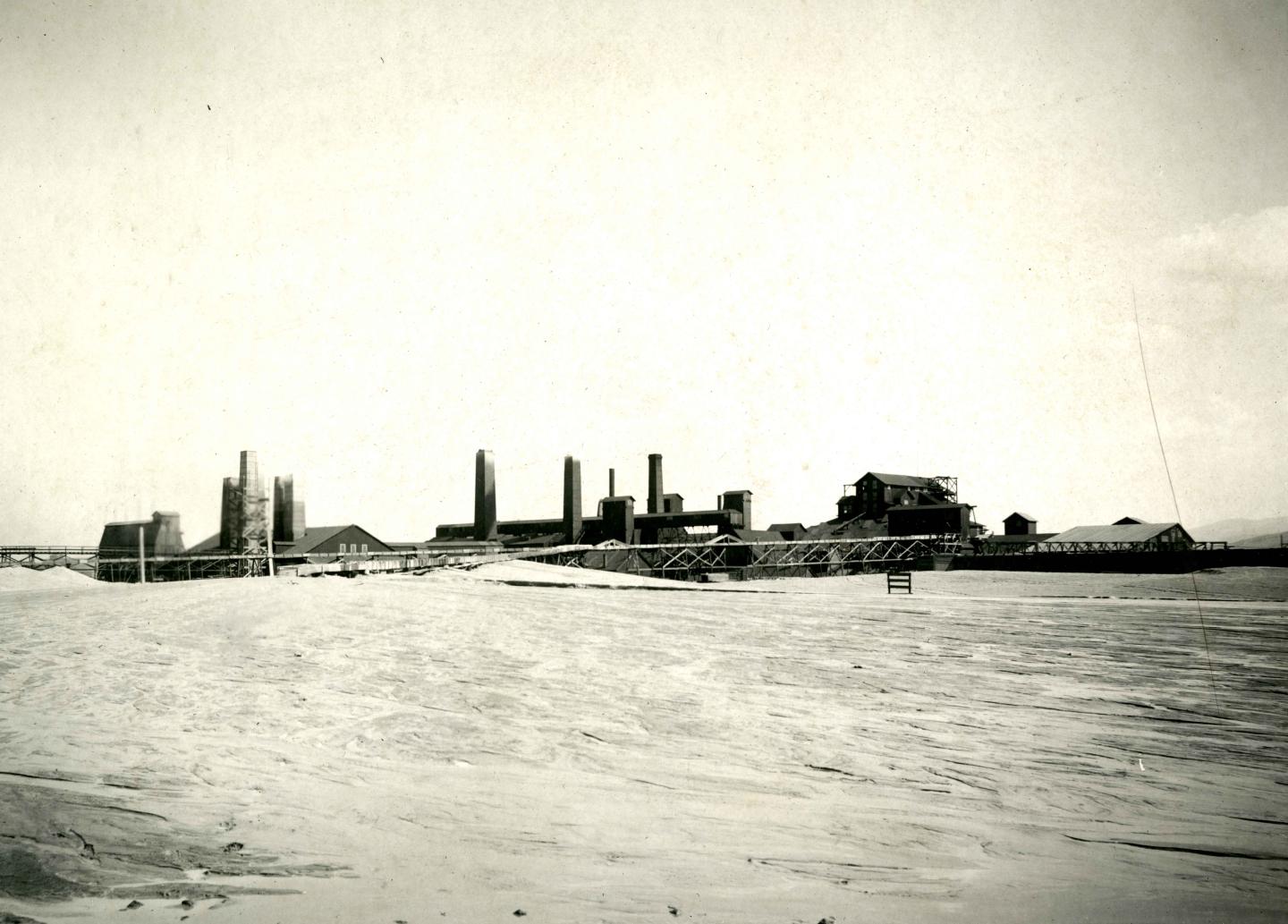
Butte Reduction Works, 1905, view to the east. Each Butte smelter, in addition to furnaces for roasting and smelting the ore, also had a concentrator, which separated as much non-metal-bearing rock, called gangue, from the ore as possible before smelting. Concentrators produced huge volumes of waste, called tailings. This photo, presented in evidence at the 1905 Magone trial about damage caused by tailings to downstream farms and ranches, shows the vast accumulation of tailings from the Butte Reduction Works. Source: National Archives and Records Administration, Denver Branch.
Building a slag wall at the Butte Reduction Works, 1909.
Building a slag wall at the Butte Reduction Works, 1909. To prevent one waste product, tailings, from washing down Silver Creek and damaging the property of farmers and ranchers, the Butte Reduction Works used another waste product, slag, to build slag walls intended to impound the tailings on-site. This photo shows the steel formwork into which molten slag was poured from ladles. Sitting next to the group of men in the background are an electric motor and a ladle car, similar to the one shown at the Parrot. The ladle carried molten slag from a smelting furnace and dumped it into the area between the forms, creating the slag walls that still exist today. Source: Wethey, "Smelting Plant of the Butte Reduction Works," Engineering & Mining Journal 88 (11 December 1909): 1153.

Location

Map

Metadata

Fred Quivik, “Smelting,” Story of Butte, accessed October 2, 2026, https://storyofbutte.org/items/show/3505.