Northern Pacific-Union Pacific Passenger Station
Passenger train stations hosted passengers and their baggage, of course, but also express, mail, money, and even bags of laundry, all carried in the “head-end” cars just behind the locomotive.
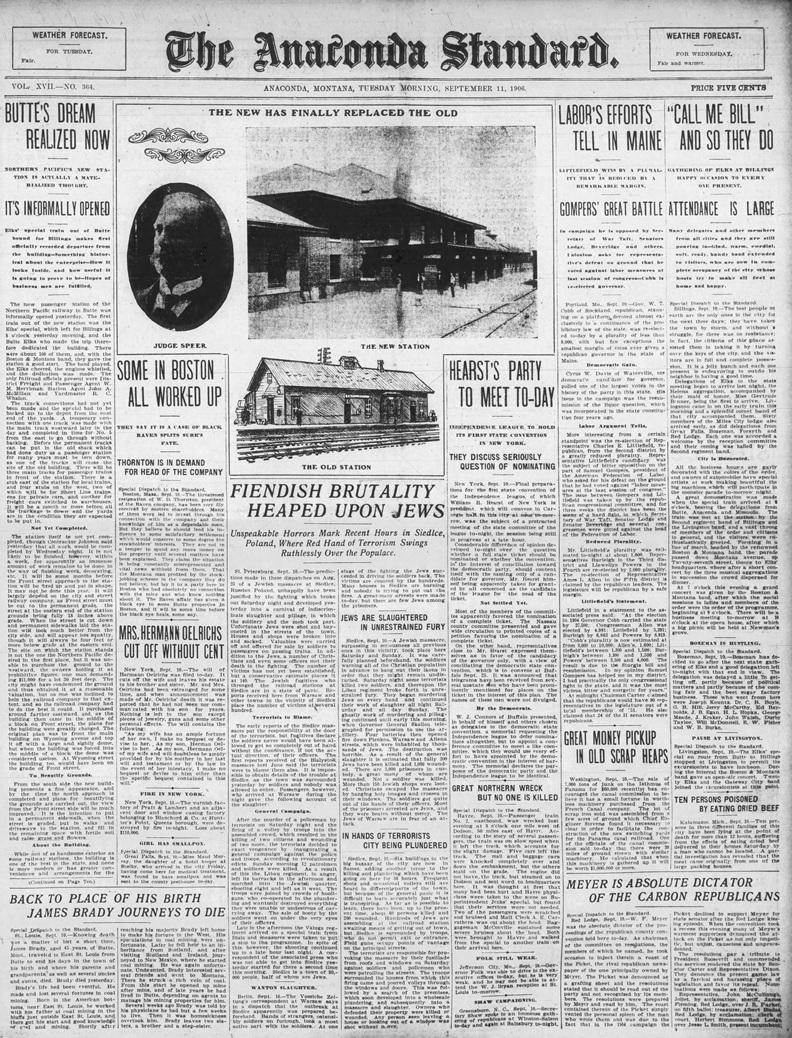
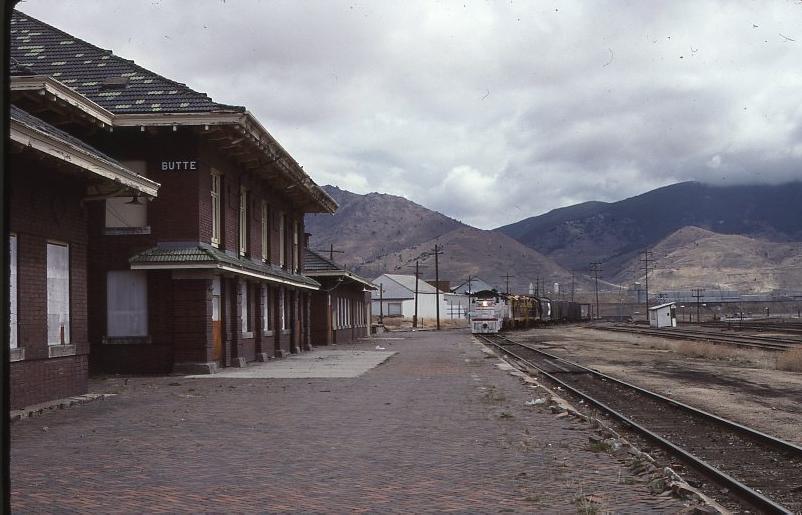
The Northern Pacific-Union Pacific station on Front Street was both the busiest and longest-operated passenger depot in Butte. Because of its location on main lines to important terminals, it was where many famous people who stopped in Butte arrived and departed. Informally opened on September 10, 1906, it served passengers and the head-end business of baggage, express, and mail until 1979. The new three-building complex replaced a small wooden building long considered by the people of Butte to be inadequate, even embarrassing.
The central two-story building housed on the first floor the large central general waiting room, smaller separate women’s and men’s waiting rooms, ticket office, and telegraph office. Railroad offices occupied the second floor. The east single-story building consisted of a restaurant and kitchen, and the Northern Pacific express office. The west building housed a large baggage room, a small mail room, and the Union Pacific express office.
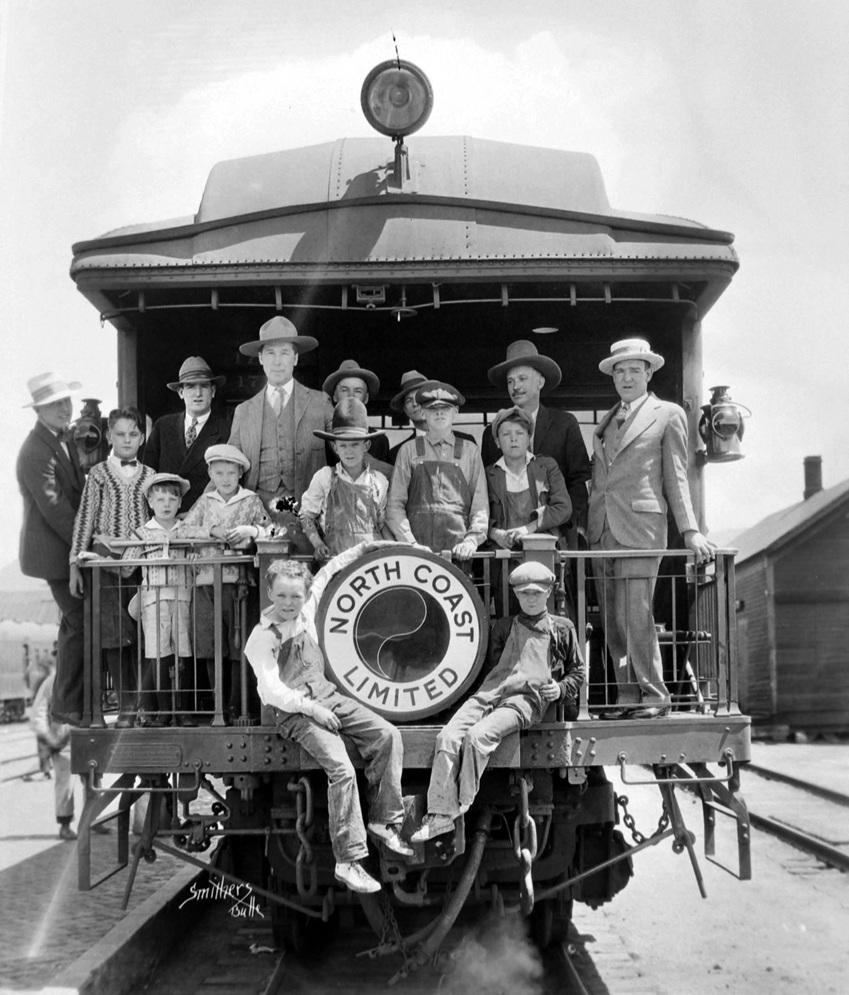
In 1916 sixteen daily passenger trains passed through, originated, or terminated at the station. On the twelve operated by the NP, long-distance schedules carried passengers without change of trains to and from St. Paul-Minneapolis, Chicago, Kansas City, St. Louis, Spokane, Seattle, and Tacoma. This included NP’s premier train, the North Coast Limited, operating between Chicago, St. Paul, Spokane, and Seattle. Local trains served dozens of places on runs to and from Missoula, Garrison, Logan, and Billings. For the Union Pacific the station was the northern terminal of a secondary line, over which it ran two pairs of trains between Butte and Salt Lake City.
Besides regularly scheduled trains, there were also “extra” (chartered) trains for special visitors and groups such as fraternal orders and sports fans. The first train out of the station in September 1906 was an extra train carrying about one hundred Butte men in the Fraternal Order of Elks travelling to Billings.
A famous, and controversial, passenger who visited Butte and detrained at the station was Eamon de Valera, leader of the Irish independence movement. He toured the U.S. in 1919, in the early months of the Irish war for independence. Butte’s large and vibrant Irish immigrant population made the city one of de Valera’s rare stops in the intermountain West. On July 25, he arrived in Butte as a passenger on the Oregon Short Line train from Salt Lake City. A “large percentage of Butte” awaited him at the station. As he stepped down from the train to the brick platform “he was besieged on all sides by anxious men and women struggling to grip him by the hand. For a few minutes he was caught in a swirling mass of humanity.” Many more people lined the parade route to uptown, where thousands welcomed him.
For a quarter century of Montana’s longest and fiercest sports rivalry, Butte hosted the annual intrastate collegiate football game. Between 1926 and 1950 (excluding the war years of 1942-45), the football teams of the University of Montana (then called Montana State University) and Montana State University (then called Montana State College) played each other in “the Butte game.” The teams played first in Clark Park on the Flat and later at Naranche Stadium at the High School. Special trains on the Northern Pacific brought fans from both Bozeman and Missoula, arriving in Butte with plenty of time to watch a parade and join festivities before the game. In 1937, a round-trip ticket on the special NP train from Bozeman cost $1.95 and the ride each way took about three hours.
By the 1960s, after decades of rail passenger decline, the station served just four daily trains, Northern Pacific’s North Coast Limited and Union Pacific’s Butte-Salt Lake City Butte Special. The federal entity of Amtrak took over almost all the nation’s remaining passenger trains in 1971, including two Chicago-Seattle trains across Montana: the Empire Builder on the Hi-Line, and the renamed North Coast Hiawatha through the large cities in the southern part of the state, including Butte. The last regularly scheduled passenger train serving Butte departed westbound from the station on October 7, 1979, when Amtrak ended the tri-weekly North Coast Hiawatha through the most populated part of the state. Freight trains still run by the depot.
Images