Milling and Concentrating

The last steps in the process of making copper metal took place at a smelter, but most copper ores had to be concentrated before being sent to the smelter.
In the early years (before 1915), copper ores were concentrated using gravity methods. First, the ore was crushed and ground to an appropriate particle size. Then the crushed ore, in a slurry with water, was sub-divided into streams of similar particle size (½-in. to ¾-in., ¼-in. to ½-in., etc.). Each stream was then sent to a set of jigs, mechanical devices that allow denser metal-bearing particles to sink in agitated water, while non-metal-bearing particles will remain suspended in the water. The dense particles were gathered as concentrate, which had a higher copper content than the raw ore, and the less-dense particles were flushed away as tailings. The particle size of tailings can range from coarse, as large as ¾-inch, to as fine as sand and even finer, to the consistency of powder (called slimes). Because gravity concentration is not 100% effective, there were still some metal values in the tailings, especially the fine tailings.
While jigs work well on relatively coarse particle sizes, they do not work well on fine solids. Concentrators therefore used other machines, called tables and vanners, that passed a slurry of fine solids and water over the textured surface of a tilted table or the surface of a moving belt with a textured surface and/or a shaking motion. These methods recovered additional copper, but the assay value of slime tailings was still often about the same as the raw ore, meaning that considerable value was lost with slime tailings.
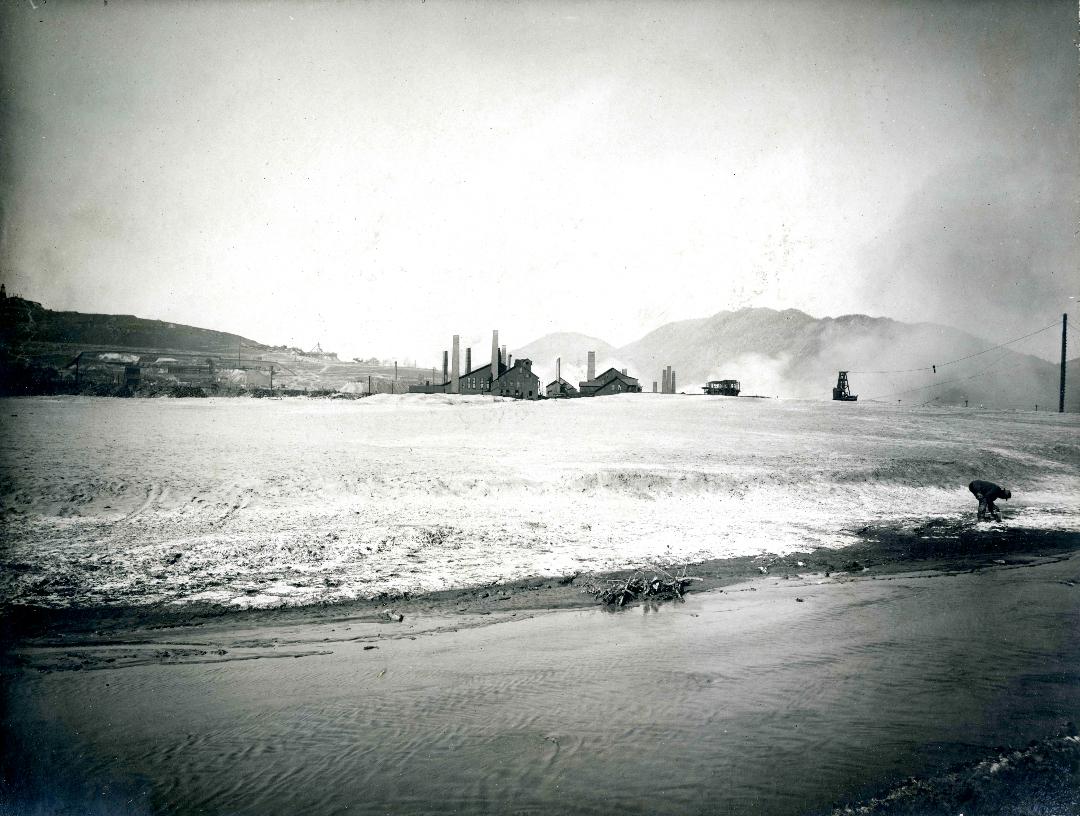
Early Butte copper concentrators often had a ratio of concentration of 2.5:1, which meant that 2.5 tons of ore yielded one ton of concentrate (and 1.5 tons of tailings). As much as 20% of the copper in the ore was lost to tailings that were discharged in dumps near the concentrator. Because companies were not particularly careful to prevent tailings from washing downstream, much of the tailings ended up on the fields of farmers downstream along Silver Bow Creek and the Clark Fork, who used the water for irrigation. Slimes were particularly damaging to land and crops, and complaints by farmers in the early twentieth century led the Butte Reduction Works to impound its tailings behind walls built of molten slag.
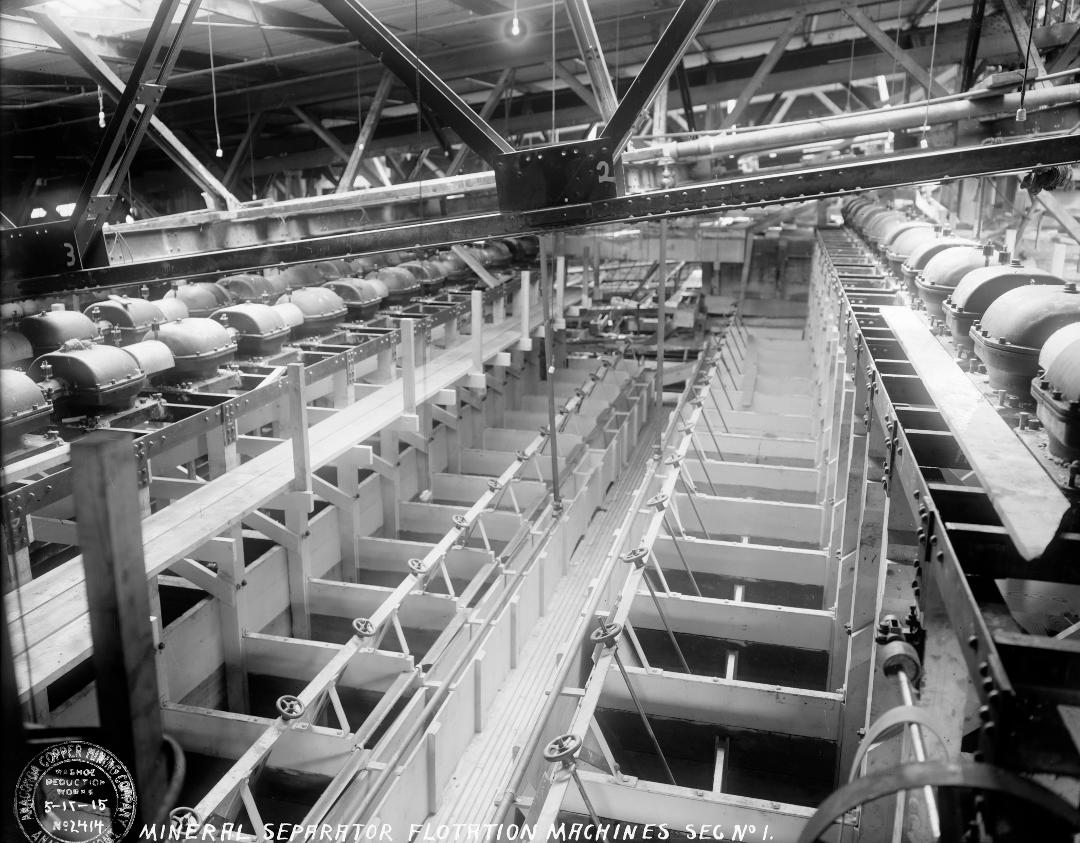
The effectiveness of concentration improved greatly after 1915 at Anaconda with the introduction of flotation, a process that adds chemicals, called reagents, to a slurry of finely ground ore so that the metal-bearing particles will adhere to bubbles rising through the slurry to the surface, while the particles of gangue (the non-metal-bearing rock) remain suspended in the slurry. With flotation, the Anaconda concentrator was able to recover as much as 96% of the copper. The froth of bubbles and fine solids could then be gathered from the surface of the slurry for smelting. The ratio of concentration for flotation changed to about 10:1, meaning 10 tons of ore yielded 1 ton of concentrate and 9 tons of tailings. Flotation tailings were much finer than gravity tailings, but they also had a much lower copper content.
After the Berkeley Pit went into operation in 1955, the Anaconda Company began to run out of space to store all its tailings near the Washoe Reduction Works at Anaconda. Moreover, it became uneconomical to haul low-grade ore by rail to Anaconda, so the company built a new concentrator on the south rim of the Berkeley Pit. Named for Clyde E. Weed, mining engineer and Anaconda Company president, the new concentrator went into operation in 1964. Using flotation, it now treats the ore Montana Resources mines from the East Continental Pit. To dispose of the tailings, the company used (and still uses) waste rock from the open-pit mining operations to build an earthen embankment across what was once the upper Silver Bow Creek watershed north of the Berkeley Pit. That earthen embankment now towers over the Berkeley Pit and is easily visible from the Berkeley Pit viewing stand and most areas on “The Flat.” The tailings behind it are called the Yankee Doodle tailings pond, named for Yankee Doodle Gulch, one of two tributaries that once formed Silver Bow Creek.
Images