Mount Moriah Cemetery
When Mount Moriah Cemetery was established in 1877, it originally consisted of four blocks: A, B, C, and D. Block A was designated for the Masons, and Block B for the Odd Fellows, who co-founded the cemetery. Block C served the general public, while Block D was used to bury members of the Chinese community until 1889, after which Chinese burials were moved to the west of the main cemetery grounds. At its inception, Mount Moriah was the only cemetery in Butte that welcomed citizens regardless of race, religion, or nationality.
In 1891, the Mount Moriah Cemetery Association was incorporated, ending direct control by the Odd Fellows and Masons. The association’s board included representatives from the lodges, prominent citizens, and mortuary owner Joseph Richards. Richards caused a stir when he left Mount Moriah and, shortly after, opened Butte’s first privately owned cemetery, Mountain View, in 1910. That same year, William Carpenter became president of the board, a position he held for 55 years. Under Carpenter’s leadership, the cemetery was beautified with the addition of trees, and it was placed on solid financial footing.
In 1910, the cemetery’s equipment consisted of one grey horse, a two-wheeled cart, and a few shovels. By 1925, the cemetery had expanded its tools to include two trucks, a gas mower, a concrete mixer, and a variety of other equipment. An endowment fund was also established in 1911 to ensure the long-term maintenance of the grounds.
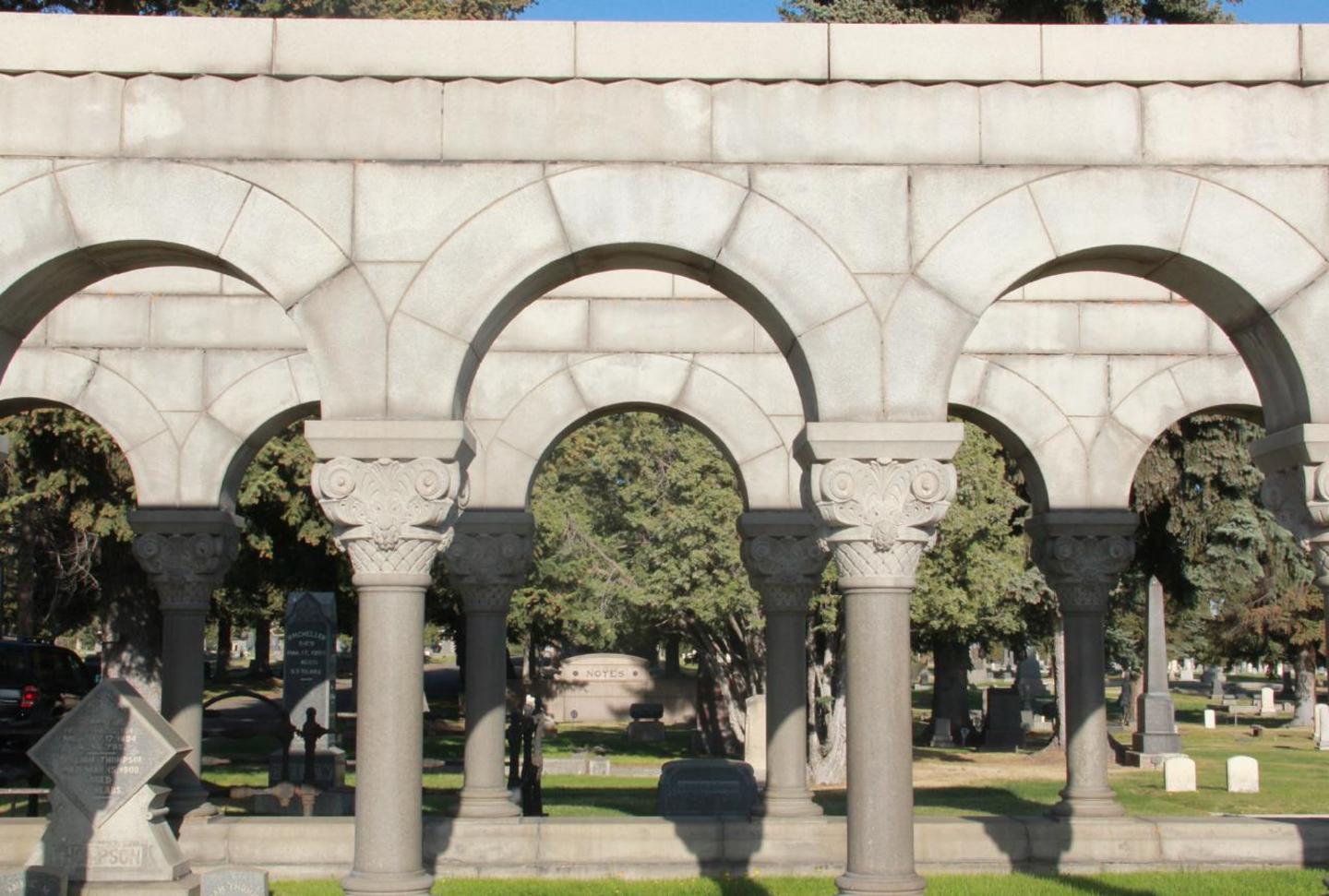
The iconic granite wall surrounding the cemetery was not part of the original layout. It was donated in the 1920s by mining millionaire William Boyce Thompson as a memorial to his parents, whose graves are located at the cemetery’s entrance beneath beautiful, arched colonnades. The wall was formally dedicated in 1929 during a large ceremony hosted by the Masons and Odd Fellows to honor Thompson. Fun fact: Thompson Park, a recreational area south of Butte, is also named after him. In 1915, Thompson deeded a large portion of land to Silver Bow County, which now serves as a community recreation area.
In addition to plots for the Masons and Odd Fellows, Mount Moriah features sections for the Serbian community, the Grand Army of the Republic, the Chinese, the Montenegrin Society, Spanish-American War veterans, and the Slovene National Benefit Society.