<?xml version="1.0" encoding="UTF-8"?>
<feed xmlns="http://www.w3.org/2005/Atom">
  <title type="text">Story of Butte</title>
  <updated>2026-07-29T16:06:02+00:00</updated>
  <generator uri="http://framework.zend.com" version="1.12.20">Zend_Feed_Writer</generator>
  <link rel="alternate" type="text/html" href="https://storyofbutte.org/"/>
  <link rel="self" type="application/atom+xml" href="https://storyofbutte.org/items/browse?output=rss2"/>
  <id>https://storyofbutte.org/</id>
  <author>
    <name>Story of Butte</name>
    <uri>https://storyofbutte.org</uri>
  </author>
  <link rel="hub" href="https://pubsubhubbub.appspot.com/"/>
  <entry>
    <title type="html"><![CDATA[Ammonium Nitrate Fuel Oil Plant]]></title>
    <summary type="html"><![CDATA[<p><strong><em>When the Anaconda Company began developing the Berkeley Pit in 1955, it quickly realized that a new type of explosive was required to break up the large volume of rock that had to be moved‒greater than 200 million tons between 1955 and 1963. The blasting agent ammonium nitrate-fuel oil (ANFO) quickly supplanted dynamite as the explosive of choice, not only in the Pit (beginning in about 1958) but also at Butte’s underground mines (beginning about 1961). </em></strong></p><img src="https://storyofbutte.org/files/fullsize/c9e6887614f20b6f714b68ae5fdcc5ef.jpg" alt="ANFO plant, view to the southeast " /><br/><p>During the late 1950s, industry wide the use of ANFO reduced the cost of explosives used in mining 50-60%. By 1975, 90% of all pit blasting in the United States was accomplished with ANFO-based blasting agents.</p><p>Anaconda Company was a regular innovator in customizing mine-related equipment and techniques at the time. Its early use of ANFO and the equipment it developed for its mixing and placement can be attributed in part to the scale of the company’s combined underground and open-pit mining operations.</p><p>The company chose a site for the delivery and mixing of ammonium nitrate and diesel oil at some distance from both the Berkeley Pit and its then-active underground mines—the former Speculator mineyard. There, the Butte, Anaconda & Pacific Railway delivered bulk fertilizer-grade ammonium nitrate prills (pellets), trucks delivered No. 2 diesel, and the work of making ANFO commenced. The bulk ammonium nitrate was dumped into an underground chute at the edge of the railroad track, then conveyed by elevator to a pair of tall storage bins.  Two large fuel tanks on high ground at the south end of the plant contained diesel that was allowed to flow through two 2-inch pipes encased in a wood box that led to the lower level of the plant.</p><p>If destined for use in the Pit, the bulk ammonium nitrate was loaded by gravity from the bottom of the storage bins into the bed of a truck that was outfitted with a large, covered bin and a separate 10,000-pound diesel tank. The truck immediately headed to the Pit where the two ingredients were mixed just prior to filling the drill holes.</p><p>If the ANFO was to be used underground, the materials were mixed together using a converted cement mixer barrel in the mixing shed—a large metal building at the ANFO plant. Workers then bagged the ANFO in 25- and 50-pound polyethylene or coated Kraft paper bags and immediately loaded them on a truck to be delivered to a mine, where it was briefly stored underground in storage magazines. The practice of using ANFO as a blasting agent underground ended at an unknown date prior to 1974 when Butte’s last underground mine closed.</p><p>The ANFO plant continued operations at the Berkeley Pit until the Anaconda Company, then owned by the Atlantic Richfield Company, permanently closed its mining operations on the Butte Hill in 1982. When the ANFO plant was abandoned, many of its working structures were left in place. Today, those structures that remain include the far end of the BA&P railroad track that led to the plant on the upper level; the chute, gates, and gate control shed that regulated the flow of ammonium nitrate to the storage bins on the middle level; and on the lower level the base of storage bins structure. Between the upper and middle level, a wood staircase for worker access continues to stand, in a deteriorated condition. Salvagers removed the mixing shed and its equipment decades ago.</p><p><em><strong><a href="https://storyofbutte.org/items/show/3598">For more (including 8 images) view the original article</a></strong></em></p>]]></summary>
    <published>2026-07-27T17:06:03+00:00</published>
    <updated>2026-07-29T16:06:02+00:00</updated>
    <link rel="alternate" type="text/html" href="https://storyofbutte.org/items/show/3598"/>
    <id>https://storyofbutte.org/items/show/3598</id>
    <author>
      <name>Mitzi Rossillon </name>
    </author>
  </entry>
  <entry>
    <title type="html"><![CDATA[End Land Use and Community Assets]]></title>
    <summary type="html"><![CDATA[<p><strong><em>End land use is an important consideration when environmental reclamation activities are interwoven and integrated with residential areas in the community, as they are in Butte. </em></strong></p><img src="https://storyofbutte.org/files/fullsize/b1bcf8f2710b996f16833aa6ace2c045.jpg" alt="Copper Mountain Recreation Complex" /><br/><p>In addition, Butte’s historic preservation efforts needed to be balanced with environmental cleanup. The regional historic preservation plan was developed to provide equal respect between economic land use, historic preservation, and environmental issues. All these pieces were considered while choosing remedial actions to protect human health and the environment. </p><p>The NRD program originally resisted providing funds for rebuilding Thompson Park, nine miles south of Butte, because they didn’t recognize that beneficial end-land use is as important a goal as the restoration of the natural resource. However, replacing the lost recreational resources by parlaying the restoration program with the remedial program has contributed to impressive end land use strategies that benefited the community. </p><p>Environmental reclamation with end land use in mind created many community assets, including the Missoula ball fields, the Alice knob walking trail, the Granite Mountain Memorial interpretive area, Foreman's Park, the Chamber of Commerce Building and the Blacktail trail, the BA&P trail, Copper Mountain Park, Skyline Park, and Big Butte.</p><p><em><strong><a href="https://storyofbutte.org/items/show/3524">For more (including 12 images) view the original article</a></strong></em></p>]]></summary>
    <published>2025-02-25T22:29:37+00:00</published>
    <updated>2026-04-17T19:58:10+00:00</updated>
    <link rel="alternate" type="text/html" href="https://storyofbutte.org/items/show/3524"/>
    <id>https://storyofbutte.org/items/show/3524</id>
    <author>
      <name>Jon Sesso</name>
    </author>
  </entry>
  <entry>
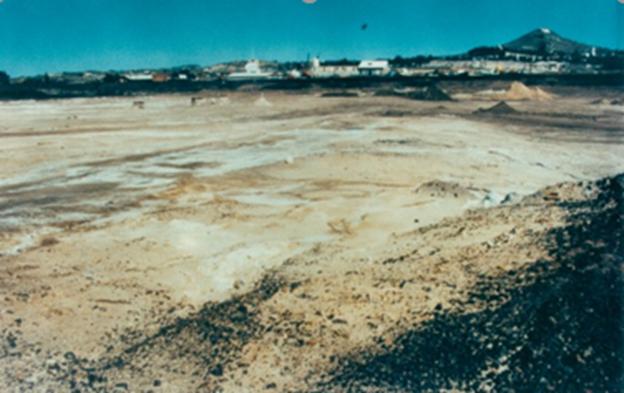
    <title type="html"><![CDATA[Surface Water Contamination]]></title>
    <summary type="html"><![CDATA[<p><strong><em>The surface water contamination in the 26-mile corridor from Butte to the Warm Spring Ponds was largely created by a 100-year flood in 1908, when floodwaters moved massive amounts of tailings from Butte mines and smelter operations down the creek. </em></strong></p><img src="https://storyofbutte.org/files/fullsize/db9b2c657a2ea3ac0cfd03ea9d3a9666.jpg" alt="Silver Bow Creek, Before" /><br/><p>The Anaconda Company learned its lesson and built the Warm Springs Ponds complex shortly thereafter. But the damage was done. Had it not been for the Superfund Program, these wastes would still be on the banks and in the streambeds of Silver Bow Creek and the Clark Fork River today.</p><p>Instead, through an integrated approach of remedial and restoration actions, Silver Bow Creek has been substantially rebuilt. Millions of cubic yards of tailings and waste have been removed from the creek corridor, the streambed and banks re-built, new vegetation planted and now flourishing, and fish have returned to the watershed, an incredible transformation. Coupled with the remedial action, ecological investments have been made in the channel to create better habitat for fisheries and aquatic species, and access features (e.g., pedestrian trail, restrooms, trailhead parking lots, and more) have been installed so the public can enjoy the restored resources along Silver Bow Creek.</p><p><em><strong><a href="https://storyofbutte.org/items/show/3523">For more (including 4 images) view the original article</a></strong></em></p>]]></summary>
    <published>2025-02-25T22:16:39+00:00</published>
    <updated>2026-04-17T19:58:10+00:00</updated>
    <link rel="alternate" type="text/html" href="https://storyofbutte.org/items/show/3523"/>
    <id>https://storyofbutte.org/items/show/3523</id>
    <author>
      <name>Jon Sesso</name>
    </author>
  </entry>
  <entry>
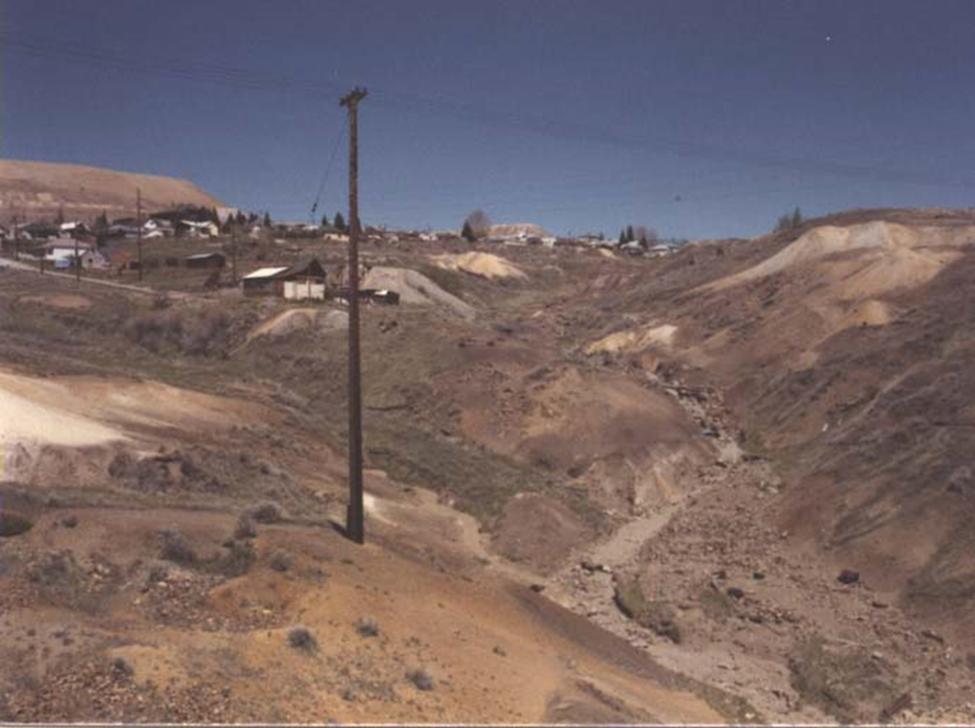
    <title type="html"><![CDATA[Stormwater and Sanitary Sewer Water Contamination]]></title>
    <summary type="html"><![CDATA[<p><strong><em>Stormwater and sanitary sewer water were also contaminated by the heavy metals that Butte's mining industry left behind. Stormwater pollution is an omnipresent challenge and has proved to be a very difficult problem to address.</em></strong></p><img src="https://storyofbutte.org/files/fullsize/52949802fb7cd7e2db44eb076996aa24.jpg" alt="Missoula Gulch, Before " /><br/><p>Because the heavy metals were so widespread at the surface on the Butte Hill, every time it rains the stormwater can sweep these metals down the 11-degree slope and deposit harmful concentrations in Silver Bow Creek and throughout its floodplain. At the same time, Butte’s municipal stormwater collection system is designed to discharge to Silver Bow Creek. This is the reason the Butte-Silver Bow government was named by EPA as a responsible party, along with ARCO and the railroads, to clean up that pollution. </p><p>In this case, the remedial cleanup response has been to 1) cap the contaminated soils on the Hill to eliminate, as much as possible, stormwater contact with the heavy metals; and 2) build a system of ditches, sediment basins and hydraulic control devices to collect the stormwater coming off the Hill. These facilities allow the heavy metals to drop out of the stormwater before reaching Silver Bow Creek. Generally, the solution has been largely successful, with more than 90% reduction in metals in stormwater discharged to Silver Bow Creek.</p><p>But more work remains. To capture the last 10%, the protective caps on the Butte Hill already in place are under review and those that don’t meet standards are being rebuilt. Other areas on the Hill that were never reclaimed (more than 100 acres) will be addressed, and maintenance protocols will continue to be assessed regularly for performance and effectiveness. Maximum action is required on the caps to eliminate contact between stormwater and heavy metals on the surface.</p><p>On the stormwater collection side another series of sediment catch basins are necessary. Over the next few years, these facilities will be installed at the bottom of the Hill, along the Silver Bow Creek corridor and in-line with the major drainages coming down the Hill – Warren Avenue Gulch, Buffalo Gulch and Missoula Gulch. </p><p>Most if not all sanitary sewer collection pipes on the Butte Hill have been embedded in mine waste and tailings since they were installed. The pipes have been deteriorated substantially by the mine waste, and when it rains, stormwater infiltrates through mine wastes into the sanitary pipelines. That water is carried to the sewage treatment plant, producing a marked increase in heavy metals reaching the plant. The solution is to dig up and replace the most deteriorated pipelines, or re-line the largest pipelines to eliminate the infiltration. A multi-million-dollar program has been established to systematically perform the work over the next 20 years.</p><p><em><strong><a href="https://storyofbutte.org/items/show/3522">For more (including 4 images) view the original article</a></strong></em></p>]]></summary>
    <published>2025-02-25T21:37:07+00:00</published>
    <updated>2026-04-17T19:58:10+00:00</updated>
    <link rel="alternate" type="text/html" href="https://storyofbutte.org/items/show/3522"/>
    <id>https://storyofbutte.org/items/show/3522</id>
    <author>
      <name>Jon Sesso</name>
    </author>
  </entry>
  <entry>
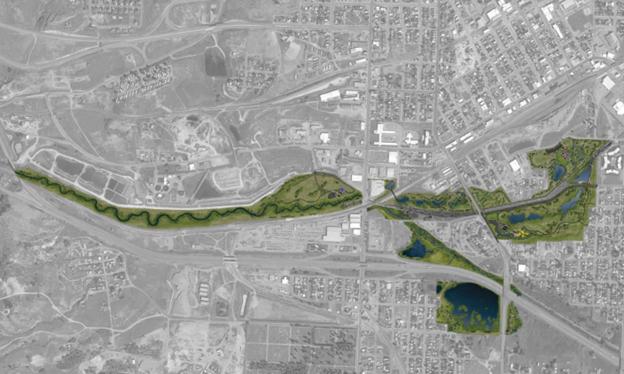
    <title type="html"><![CDATA[Protecting the Alluvial Aquifer]]></title>
    <summary type="html"><![CDATA[<p><strong><em>Groundwater pollution impacted the alluvial aquifer along the Silver Bow Creek corridor and floodplain in the central part of Butte. The cleanup decisions and strategy have been multi-faceted.</em></strong></p><img src="https://storyofbutte.org/files/fullsize/548a9c4cd7d217c5a3e8ec13c661da1b.jpg" alt="Future Remediation Plan" /><br/><p>Starting in 1996 and ongoing today, the alluvial groundwater is collected through a system of French drains and wells, and the contaminated water is then routed to the Butte Treatment Lagoons (west of Montana Street). After treatment there, the clean water is discharged to Silver Bow Creek.</p><p>The Parrot Tailings Project was completed in 2022 and removed about 700,000 cubic yards of highly contaminated materials from the Silver Bow Creek floodplain, most of which were more than 40 feet below the surface and in contact with alluvial groundwater. The Project also collected nearly 30 million gallons of contaminated water from the aquifer and pumped it to the Montana Resources mine area, to produce a marked improvement in groundwater quality in the Silver Bow Creek corridor.</p><p>The Silver Bow Creek Conservation Area Project is in design now and expected to be implemented starting in 2025. It involves the removal of another one million cubic yards of contaminated materials in proximity to alluvial groundwater. The project also includes a series of sediment basins to collect stormwater coming down off the Butte Hill, where during large storm events heavy metals can drop out before the water is allowed to enter Silver Bow Creek. After these remedial actions are complete, a 120-acre park with recreational facilities will be built in the area as the end land use.</p><p>The Montana Pole and Treating Plant Project is unique in the Butte Superfund story – instead of a heavy metals problem, the chief contaminant at this site is pentachlorophenol (PCP) which was mixed with oil to preserve poles, posts and bridge timbers. The hazardous substances were discharged to a ditch which eventually flowed to Silver Bow Creek, contaminating the soil, sediment, surface water and groundwater throughout the 80-acre site. By 2022, most of the surface contamination was remediated, but the remnants of PCP/oil mixture will have to be pumped up with the groundwater and processed through an onsite, specialized water treatment facility for the next 20 years.</p><p><em><strong><a href="https://storyofbutte.org/items/show/3521">For more (including 4 images) view the original article</a></strong></em></p>]]></summary>
    <published>2025-02-25T21:20:23+00:00</published>
    <updated>2026-04-17T19:58:10+00:00</updated>
    <link rel="alternate" type="text/html" href="https://storyofbutte.org/items/show/3521"/>
    <id>https://storyofbutte.org/items/show/3521</id>
    <author>
      <name>Jon Sesso</name>
    </author>
  </entry>
  <entry>
    <title type="html"><![CDATA[Groundwater Contamination]]></title>
    <summary type="html"><![CDATA[<p><strong><em>Mining in Butte severely impacted water resources – groundwater, stormwater, surface water, drinking water, and even sanitary sewer water – all contaminated by the heavy metals brought to the surface from the Richest Hill on Earth.</em></strong></p><img src="https://storyofbutte.org/files/fullsize/4bb60e6d01b97fb6c82e9383d488936f.jpg" alt="Butte Before the Pit" /><br/><p>The seminal contributor to groundwater contamination is the Berkeley Pit, a problem created in 1982 when ARCO ceased mining activities and turned off the pumps at the 3,900-foot level below the surface in the Kelly Mine. Thousands of miles of underground mine workings and the Berkeley Pit flooded as the groundwater started rising to its natural level. In the Pit, that water, when exposed to heavy metals on the Pit walls and air (oxygen), became a toxic soup that requires perpetual monitoring and management. </p><p>Given the adverse impacts of this contamination, the groundwater in large portions of Butte’s urban area can’t be used for drinking. The extent of the damage, in volumetric and economic terms, is enormous. For just the bedrock aquifer on the Butte Hill, lost ground water resources are estimated at 6,900 gallons per minute (gpm). By comparison, 5,000 gpm equates to seven million gallons per day, which is about the average amount of water used by Butte citizens on a typical day. In economic terms, approximately 3,000 residential properties and 350 commercial parcels are situated over the contaminated aquifers on the Hill. If these aquifers were not contaminated, the residents and businesses could have used a substantial portion of the groundwater resources as a source of drinking water through private wells. </p><p>By 1994, the EPA determined that it was “technically impractical” to remediate this contamination. They stipulated that, to protect human health, a ground water control area and other restrictions needed to be put in place to limit the use of existing wells and prohibit new wells in specific areas. EPA also approved the proposed plan from ARCO and Montana Resources (the active mine operator in 1994 and still today) to allow the groundwater to enter the Berkeley Pit until the level reached 5,350 feet above sea level. This is about 60 feet below a “Critical Water Level” where contamination could potentially begin to adversely affect alluvial groundwater resources. Once the water level in any of the underground mines surrounding the Pit reached 5,350, which occurred in 2018, pump and treat operations began. Today, approximately seven million gallons per day are pumped out of or diverted away from the Berkeley Pit, processed through two treatment plants, and used in active mining operations or discharged into Silver Bow Creek.</p><p><em><strong><a href="https://storyofbutte.org/items/show/3519">For more (including 5 images) view the original article</a></strong></em></p>]]></summary>
    <published>2025-02-25T21:00:00+00:00</published>
    <updated>2026-04-17T19:58:10+00:00</updated>
    <link rel="alternate" type="text/html" href="https://storyofbutte.org/items/show/3519"/>
    <id>https://storyofbutte.org/items/show/3519</id>
    <author>
      <name>Jon Sesso</name>
    </author>
  </entry>
  <entry>
    <title type="html"><![CDATA[Residential Metals Abatement Program]]></title>
    <summary type="html"><![CDATA[<p><strong><em>More than 4,000 properties in Butte – and that number will continue to increase – became collection points for heavy metals, including residential neighborhoods, school playgrounds and parks. </em></strong></p><img src="https://storyofbutte.org/files/fullsize/cdffcfd8a4d0104f94409e8ec1c54e8a.jpg" alt="Residential Attic Cleanup" /><br/><p>Homes, schools and parks were either built on top of soils containing heavy metals, or dust in the air from mining and smelting activities settled on the ground or in house attics. These threats to human health were able to be addressed because of the Superfund program. </p><p>Between 1995 and 2024, after extensive sampling to identify and locate where metals contamination exceeded standards – specifically for lead, arsenic and mercury – almost 3,000 properties were abated, while another 1,000 properties are on a waiting list. In October 2024, the EPA proposed more stringent cleanup standards for these contaminants, triggering re-sampling of many properties, increasing the footprint of the area to be sampled, and adding thousands of properties to the abatement list to be addressed under the Superfund Program.</p><p>In this case, the remedy is all about protecting human health. If contaminant levels exceed the standard, 12 inches of soil is removed from the yards/parks/play areas and replaced with clean soil and sod or whatever ground covers the owner had in place. Interior spaces, with an emphasis on attics, are cleared of dust and other materials, such as contaminated insulation, using high powered vacuums. </p><p>The Program, which also includes biomonitoring and blood lead testing for children – the population most sensitive to lead poisoning – is expected to continue in Butte over the next several decades, and until such time as all threats to human health have been addressed.</p><p><em><strong><a href="https://storyofbutte.org/items/show/3518">For more (including 3 images) view the original article</a></strong></em></p>]]></summary>
    <published>2025-02-25T20:23:01+00:00</published>
    <updated>2026-04-17T19:58:10+00:00</updated>
    <link rel="alternate" type="text/html" href="https://storyofbutte.org/items/show/3518"/>
    <id>https://storyofbutte.org/items/show/3518</id>
    <author>
      <name>Jon Sesso</name>
    </author>
  </entry>
  <entry>
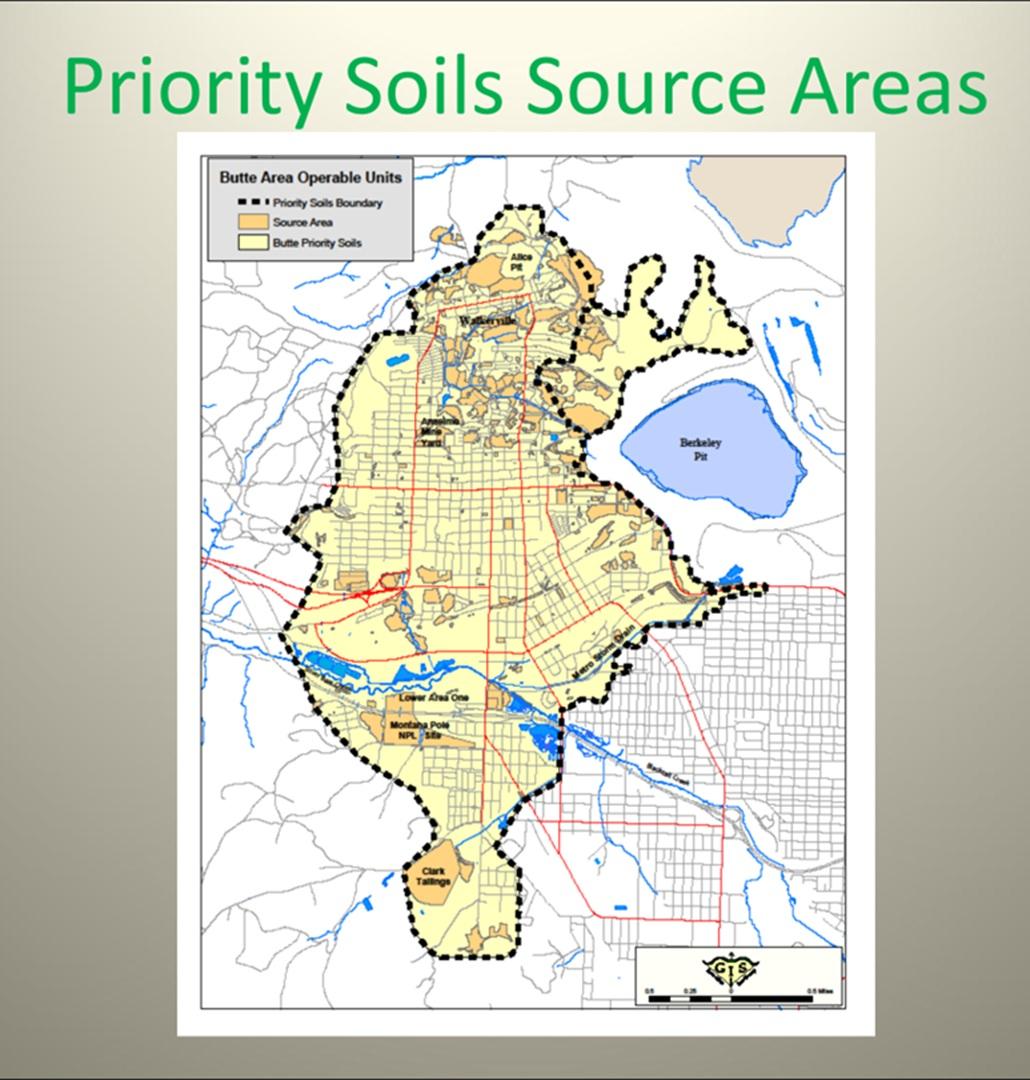
    <title type="html"><![CDATA[Soil Cleanup]]></title>
    <summary type="html"><![CDATA[<p><strong><em>In telling the Superfund story about how decisions were made to clean up the soil in Butte, it’s important to understand just how prevalent the heavy metals were and remain in that soil. </em></strong></p><img src="https://storyofbutte.org/files/fullsize/9cfc9a9cb141a0d70ead32d9d53668c9.jpg" alt="Priority Soils Map" /><br/><p>Butte is often called the Richest Hill on Earth, mostly because of the millions and millions of tons of copper mined from the earth and used to fight world wars and electrify the nation. But the reality is that the earth underlying Butte is made up of many other elements. Butte’s soil and ore bodies contain molybdenum, gold, silver, aluminum, zinc, lead, manganese, iron, cadmium, and more, all of which, at one time or another, were mined in and around Butte. In addition, arsenic is attached to the ore bodies, which, when brought to the surface, created another serious environmental hazard.</p><p>Of course, not everyone considered the arsenic a problem. In fact, in 1889, when Copper King William Clark was confronted about the issue, he famously retorted, “there’s just enough arsenic there” that the women “are renowned wherever they go for their beautiful complexions.” The same William Clark, giving the final speech of his short tenure after having bought a seat in the US. Senate, related jousting with President Theodore Roosevelt and his Forest Service Chief Gifford Pinchot about the ill effects of mining and boasting how “Those who succeed us can well take care of themselves.”</p><p>Compounding the issue of abundant heavy metals in the soil were past mining and smelting practices. From the giant Anaconda Company to the hundreds of individual miners prospecting their claims, the ore bodies would be brought to the surface, the precious metals separated out and sold off, and the spoils (i.e., tailings and waste rock) left on the ground or next to the stream to decay and erode as part of the landscape and environment. Further, those spoils would be used to backfill foundations for commercial buildings and residential homes, or as the base course for city streets and ballast for railroad corridors.</p><p>Along comes Superfund and the challenge of mitigating the adverse impacts of these heavy metals. What to do, and how to do it? Total removal was investigated and evaluated, but judged impractical. Then, how far down to dig? – there was really no bottom level where the heavy metal concentrations would be acceptable to protect humans and the environment. </p><p>Consequently, the most prevalent soil cleanup remedy used in Butte has been a waste-in-place/capping technique: removing the top 18 inches of dirt which contains the highest concentration of metals and contaminants, regrading the surfaces to minimize erosion from stormwater runoff, importing clean fill materials (metals-free, to the greatest extent possible), and covering the surface with enough healthy (organic content) topsoil to support a vegetated “protective cap.” The caps are then monitored for performance and effectiveness to eliminate human contact with the heavy metals and stormwater runoff carrying metals down the steep pitch of the Butte Hill to the tiny, low-flow surface streams at the bottom, Blacktail Creek and Silver Bow Creek.</p><p>On the Butte Hill, there are approximately 200 individual mine waste source areas that have been identified, mapped, reclaimed and are now being monitored, ranging in size from one-half to 50 acres. Over the years, there have been fits and starts in learning how to build the protective caps properly and keep the vegetation in good condition. Many sites have performed well; several have not and have had to be redone periodically to meet performance objectives. This waste-in-place remedy requires a perpetual maintenance effort, which is managed and implemented by the local government and paid for by ARCO. Trust funds have been established to ensure the residents of Butte will never bear the cost of these maintenance activities.</p><p>Another important aspect of the waste-in-place remedy and an overarching chapter of the Superfund story is the community’s demand for beneficial end land uses of the capped sites and remediated areas. In other words, if the community is going to tolerate forever that the heavy metals are buried underground, there needs to be tangible, long-term benefits in compensation. The results have been significant throughout the community, including parks, open space areas and a multi-million-dollar Redevelopment Trust. </p><p><em><strong><a href="https://storyofbutte.org/items/show/3517">For more (including 9 images) view the original article</a></strong></em></p>]]></summary>
    <published>2025-02-25T17:10:39+00:00</published>
    <updated>2026-04-17T19:58:10+00:00</updated>
    <link rel="alternate" type="text/html" href="https://storyofbutte.org/items/show/3517"/>
    <id>https://storyofbutte.org/items/show/3517</id>
    <author>
      <name>Jon Sesso</name>
    </author>
  </entry>
  <entry>
    <title type="html"><![CDATA[Superfund Legislation]]></title>
    <summary type="html"><![CDATA[<p><strong><em>Until 1980, there was very little that could be done to abate and mitigate the adverse impacts of Butte's mining industry on residents and the environment. There were no laws that governed the historic mining activities, and no violations to enforce. Then things changed.</em></strong></p><img src="https://storyofbutte.org/files/fullsize/70d3cb571af02df5b509f9479061e93d.jpg" alt="1889 Landscape" /><br/><p>In 1980, the U.S. Congress, faced with mounting legacy pollution problems across the country (e.g., companies discharging toxic substances in public waterways and landfills), enacted a new federal law – CERCLA, the Comprehensive Environmental Response, Compensation, and Liability Act. The law is commonly referred to as Superfund because provisions of the statute created taxes levied on chemical and oil companies, among others, with proceeds deposited in an independent “fund.” This fund was used to empower the U.S. Environmental Protection Agency to identify and compel responsible parties to clean up hazardous sites, and to pay for cleanups at “orphan” sites where no liable party could be identified. </p><p>The Superfund statute is quite unique (and controversial) in that it can be enforced retroactively, after the pollution occurred and regardless of whether the polluter (aka, the responsible party) did or did not violate any other environmental laws when creating the hazardous conditions. For Butte, the ramifications of this new law were truly transformational in terms of addressing the pollution impacts of the past that would never have been dealt with otherwise.</p><p>By 1983, the Butte/Silver Bow Creek Site, including the Berkeley Pit, was among the first sites placed on the Superfund National Priority List – the first of four regional federal Superfund Sites extending over 120 miles from Butte to the Milltown Dam in Milltown along and within the Upper Clark Fork River Basin. Then and still today, these four sites together constitute the largest Superfund site in the United States.</p><p>In a very significant way Butte’s Superfund story started a few years earlier, in 1976, when the Atlantic Richfield Company (now the British Petroleum/Atlantic Richfield Company, hereinafter referred to as ARCO) bought all Anaconda Company holdings. Hence, when CERCLA became law in 1980, ARCO was on the hook to pay for most of the Superfund cleanup actions in the Upper Clark Fork River Basin. Essentially, ARCO would have to pay the tab for all the pollution that occurred under decades of Anaconda Company ownership. Thus began what has now been an over 40-year journey of a multitude of remediation actions compelling ARCO to perform and manage soil and water cleanup work on the Butte Hill, the Berkeley Pit and the Silver Bow Creek corridor/watershed.</p><p>ARCO was also responsible for restoration damages in Butte and the Upper Clark Fork River Basin (the second part of CERCLA) that would ultimately lead to a multi-million-dollar ($188 million plus interest earned) settlement with the State of Montana. The funds have been used by the State since 1999, in concert with remedial work, to restore and replace damaged and lost natural resources in the Basin. </p><p><em><strong><a href="https://storyofbutte.org/items/show/3516">For more (including 7 images) view the original article</a></strong></em></p>]]></summary>
    <published>2025-02-25T16:29:07+00:00</published>
    <updated>2026-04-17T19:58:10+00:00</updated>
    <link rel="alternate" type="text/html" href="https://storyofbutte.org/items/show/3516"/>
    <id>https://storyofbutte.org/items/show/3516</id>
    <author>
      <name>Jon Sesso</name>
    </author>
  </entry>
  <entry>
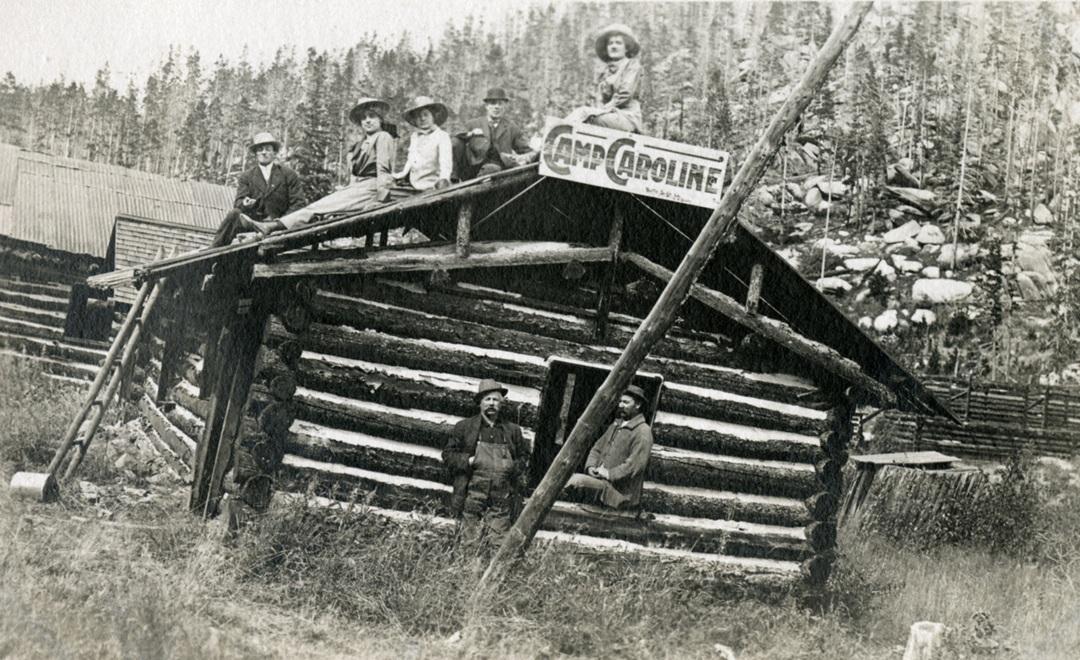
    <title type="html"><![CDATA[Using Back and Brawn to Build Community]]></title>
    <summary type="html"><![CDATA[<p><strong><em>While some African Americans in Butte were doctors, lawyers, and business owners, most Black residents worked humble jobs, using their backs and brawn to build homes, neighborhoods, and community. African American miners, waitresses, porters, cooks, maids, and seamstresses worked to keep the city afloat. </em></strong></p><img src="https://storyofbutte.org/files/fullsize/9d45000820428142a4a10a51492bf609.jpg" alt="Camp Caroline" /><br/><p>Prejudice largely accounts for the limited professions offered to minority communities. Black residents in Butte took those limits and patronized where they were accepted and comfortable. Thus, Butte once had three nightclubs, two shoeshine parlors, and two restaurants that served a strictly Black clientele.</p><p>Mining was the most prominent, and arguably important, job in Butte. The city was founded off the capital and success of taking gold, silver, and copper from the ground. The profession was very dangerous; many risked their lives and thousands perished while traveling deep into the mines for work.</p><p>Although mining was not seen as a glamourous job, many mining companies would not hire the Black community solely because of the color of their skin. Marcus Daly, one of the three copper kings in Butte, was notorious for refusing employment to African Americans in his mines.</p><p>Camp Caroline, just west of the Continental Divide off Homestake Pass, was not geographically connected to Butte, but its cultural and business connections to the city and the Black community run deep. Richard Brown worked as a hoisting engineer at the Mountain Chief mine at Camp Caroline, one of the few African Americans to work as a miner in Butte. African American wood cutters produced firewood and timber for Butte’s residents and businesses. The Brown family operated a boarding house at Camp Caroline that served the miners and timber cutters within the Homestake area, and being the only place to eat in a fourteen-mile radius, racial differences were of little issue. The boarding house also served as a recreational center for the Black community. Many descendants of the Brown family still live in Butte and own the mining claims and land near Camp Caroline.</p><p><em><strong><a href="https://storyofbutte.org/items/show/3513">For more (including 3 images) view the original article</a></strong></em></p>]]></summary>
    <published>2025-02-07T21:30:53+00:00</published>
    <updated>2026-04-17T19:58:10+00:00</updated>
    <link rel="alternate" type="text/html" href="https://storyofbutte.org/items/show/3513"/>
    <id>https://storyofbutte.org/items/show/3513</id>
    <author>
      <name>Story of Butte</name>
    </author>
  </entry>
  <entry>
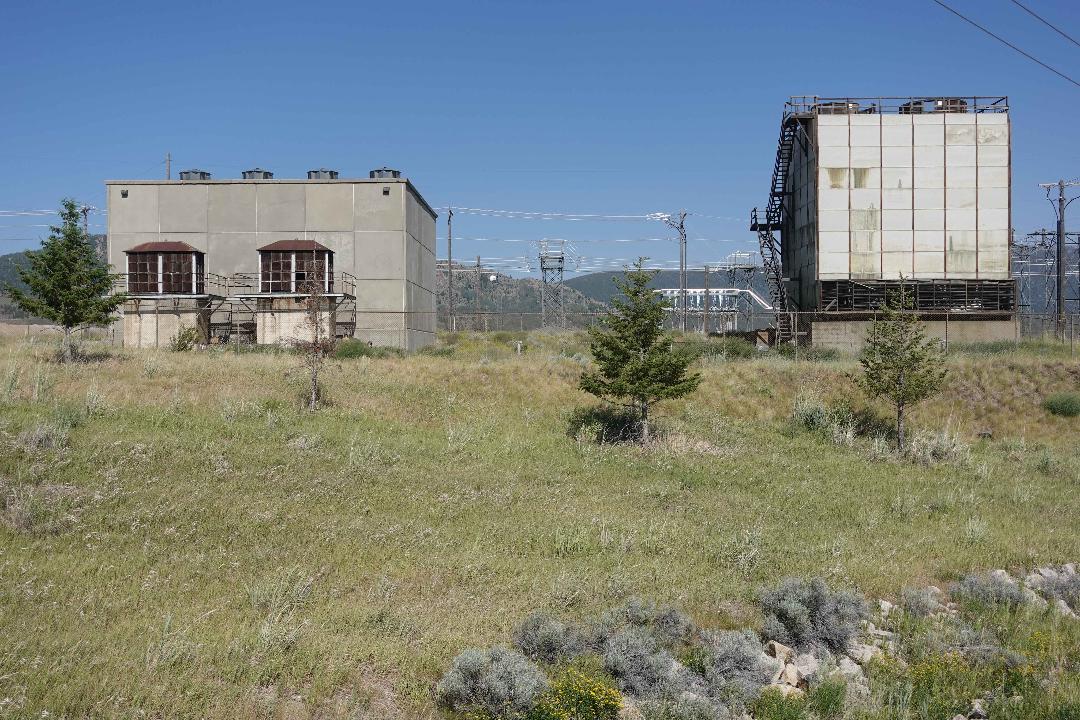
    <title type="html"><![CDATA[Compressed Air]]></title>
    <summary type="html"><![CDATA[<p><strong><em>One of the most effective means of transmitting and storing power is compressed air, which was a major factor in mechanizing many facets of mining in Butte.</em></strong></p><img src="https://storyofbutte.org/files/fullsize/9b8e8a3e5551b4d6c0ea0b33a2dd2152.jpg" alt=" Corra Compressor, next to the Granite Mountain Memorial." /><br/><p>Mechanization entails several factors, including machines that can do the work once done by human hands, sources of energy to power the machines, and effective means of transmitting and storing the power so that it can be used by the machines when needed. </p><p>Prior to 1910, each mineyard in Butte was a distinct operation, with its own source of energy to fire boilers and drive the mine’s hoisting engine, air compressor, machine shop, framing shop, etc. Each mineyard therefore needed its own supply of coal, which was expensive. The mines had already begun to rely on electricity to light the underground workings and to power small locomotives for tramming ore on the surface. Beginning around 1900, mines started converting their air compressors and pumps to electric power as well. As Anaconda Copper Mining Company (ACM) began consolidating the hydroelectric generating stations in Montana to form the closely allied Montana Power Company, ACM engineers began to study whether it would be feasible to use electric power for hoisting as well. ACM and its associated companies (all under Amalgamated control) operated 22 mines in Butte, 15 of which had fairly large hoisting engines. The engineers concluded that it would be impractical to convert them all to electric hoisting, because each shaft operated on its own schedule, meaning fluctuations in the electric load would be too large and erratic for the controls at the distant hydroelectric stations to respond sufficiently to provide power when it was needed. A better solution would be to use the electricity to produce compressed air.</p><p>ACM built a centralized compressor plant at the High Ore mine. The plant was equipped with giant receivers, the tanks that hold compressed air. Those receivers would allow the electric motors and compressors to run efficiently at a constant speed. A network of pipes then delivered compressed air across the Butte Hill to each of the mineyards. Only minor modifications were required to convert existing steam hoists to hoisting engines powered by compressed air. New receiver tanks next to each hoist house were connected to the network of pipes constantly supplied with compressed air, and the receivers provided nearby storage to assure that there was sufficient air to satisfy the sudden load when an engine started hoisting rock. The centralized compressor plant and the network of pipes also meant that each mine no longer had to supply its own compressed air for the rock drills underground, although some mines, like the Original, Diamond, and Leonard continued to operate large compressor plants for rock drills.</p><p>By the late 1920s, control mechanisms at hydroelectric dams were sufficient to respond to sudden surges in load, making it possible for ACM to start replacing old hoisting engines with new electric hoists. Today, all the surviving hoisting engines in Butte are electric except those at the Original and the Steward, which are the old steam hoisting engines that were converted to compressed air. The Anaconda Company eventually took the Butte Hoist Plant at the High Ore out of service as the need for compressed air declined when mines converted to electric hoisting, and as expansion of the Berkeley Pit began to encroach on the High Ore mineyard. It was replaced with smaller compressor plants at the Kelley mine and the site of the former Corra mine. </p><p><em><strong><a href="https://storyofbutte.org/items/show/3511">For more (including 8 images) view the original article</a></strong></em></p>]]></summary>
    <published>2025-01-07T02:11:30+00:00</published>
    <updated>2026-04-17T19:58:10+00:00</updated>
    <link rel="alternate" type="text/html" href="https://storyofbutte.org/items/show/3511"/>
    <id>https://storyofbutte.org/items/show/3511</id>
    <author>
      <name>Fred Quivik</name>
    </author>
  </entry>
  <entry>
    <title type="html"><![CDATA[Electricity and Mining]]></title>
    <summary type="html"><![CDATA[<p><strong><em>The first couple decades of Butte’s mining boom were based on the technological advancements of the Industrial Revolution: burning coal, using steam to generate mechanical power, the linking of urban markets to remote regions like Butte by means of the railroad.</em></strong></p><img src="https://storyofbutte.org/files/fullsize/9ee8d6f6eb9be34fe1bde6b1da71268e.jpg" alt="The steel transmission towers extending across the Butte Hill, just south of the intersection of North Idaho and Pacific, are part of a transmission line running from Great Falls to Anaconda. " /><br/><p>Butte copper then helped supply the wiring for the Second Industrial Revolution, which was based in part on electrification. After a slow start in electrifying mining operations in the late nineteenth century, Butte engineers developed many ways in the early twentieth century to use electricity to greatly lower mining costs.</p><p>The Alice Silver Mining Company was the first Butte company to install electric lights in its mine and mill. Installed in late 1880, it was the technology of the Brush Electric Lighting System, which used electric arcs between two carbon electrodes, rather that the incandescent light bulbs that Thomas Edison would introduce two years later. Although Butte had an electric lighting company supplying electricity to customers in the central business district by 1884, most mines that installed arc lighting in the wake of the Alice’s introduction owned their own generating plants at their mineyards. Butte and its mines continued to be serviced with electricity generated with coal-fired steam until the turn of the twentieth century, when three hydroelectric generating stations started transmitting power to Butte from dams on the Big Hole River, the Missouri River at Canyon Ferry, and the Madison River near Ennis. By this time, mines were also using electricity for tramming ore and pumping water from the mines. The next big plant built to supply the mining industry at Butte with electricity was the Missouri River Power Company, which operated the Canyon Ferry dam. It built the Hauser dam and generating station north of Helena in 1907. Disaster struck that company in April 1908, when a flood washed out the dam.</p><p>Meanwhile, John D. Ryan, president of Amalgamated Copper Company, the holding company that by 1908 owned Anaconda Copper Mining Company (ACM) and most of Butte’s other large mining companies, was negotiating to gain control of the rights to the hydropower sites along the Missouri River at Great Falls. There, the Black Eagle Dam was already supplying electricity to the Great Falls smelter of the Boston & Montana Consolidated Copper & Silver Mining Company (one of the Amalgamated companies). As engineers for Amalgamated and ACM were investigating how to reduce costs at Butte and Anaconda by expanding the uses of hydroelectricity, Ryan moved to build a new dam and generating station at Rainbow Falls, just below Great Falls. To convey electricity from Rainbow Falls to Butte, the Great Falls Power Company built a 130-mile transmission line, completed in May 1910. The 102 kilovolt transmission wires are supported by steel towers built in tandem so that, if lightning knocked out the power on one set of lines, the other set of lines could still supply the mines and not interrupt operations. </p><p>Much of that transmission line is still visible on the Montana landscape. Close to Butte, the double sets of 1910 transmission towers, which are visible from I-15 in Elk Park, embody the way ACM incorporated vast areas of Montana into the company’s technological system. Most of the electricity from Great Falls was used at the mines for hoisting, operating rock drills, and running pumps and ventilating fans, but nearly half of the electricity was sent on to Anaconda for use at the smelter for powering the machines in the concentrator, running blowing engines, and operating cranes and other power equipment. Some of the transmission towers of that line to Anaconda still stand on the Butte Hill, and along Montana Highway 1 from I-15 into Anaconda. Shortly after completion of the Rainbow Falls dam and powerplant, Ryan was able to consolidate the Great Falls Power Company, the Missouri River Power Company, and other systems to form the Montana Power Company (MPC, predecessor of Northwestern Energy), establishing the once-close relationship between MPC and ACM.</p><p><em><strong><a href="https://storyofbutte.org/items/show/3510">For more (including 8 images) view the original article</a></strong></em></p>]]></summary>
    <published>2025-01-07T01:49:16+00:00</published>
    <updated>2026-04-17T19:58:10+00:00</updated>
    <link rel="alternate" type="text/html" href="https://storyofbutte.org/items/show/3510"/>
    <id>https://storyofbutte.org/items/show/3510</id>
    <author>
      <name>Fred Quivik</name>
    </author>
  </entry>
  <entry>
    <title type="html"><![CDATA[Open-Pit Mining and Block-Caving]]></title>
    <summary type="html"><![CDATA[<p><strong><em>Butte’s first small boom in the 1860s was based on miners finding gold using placer-mining methods (washing sands and gravels to recover particles of gold). </em></strong></p><img src="https://storyofbutte.org/files/fullsize/84f5dee9a5ed1add5ca6a4f5162314b1.jpg" alt="Kelley mine, view to the southeast, showing the mine’s two headframes. " /><br/><p>Butte’s sustained boom began in the 1870s, when miners found ways to exploit rich veins of ore from underground workings. That boom lasted seven decades, until the 1940s, when depletion of the rich veins and competition from copper mines elsewhere threatened to make mining in Butte unprofitable. Anaconda Copper Mining Company (ACM) responded by implementing newer methods, block-caving and open-pit mining, aimed at exploiting the remaining lower-grade ore beneath the Butte Hill.</p><p>Underground mining is traditionally a labor-intensive undertaking. In the nineteenth century, many aspects of underground mining had been mechanized. Machine drilling accelerated the drilling of holes in the rock for explosives; ore cars on wheels, which ran along tracks and were often pulled by horses or mules, greatly enhanced miners’ ability to move ore horizontally through mine workings to the shaft; and steam-powered hoisting allowed companies to lift large tonnages of ore vertically out of a mine. One task remained stubbornly labor-intensive: once the ore was broken by explosives, it still had to be laboriously loaded by muckers into ore cars using hand shovels. The need to use hand shovels for excavations changed broadly in the early nineteenth century with the invention of the steam shovel, but they were too bulky for use underground. </p><p>Surface mining using steam or electric shovels brought several low-grade copper mines in the American Southwest into production in the first quarter of the twentieth century, but underground mining remained the preferred method in the Butte mines because of the depth and richness of the ore. It remained profitable at Butte to have skilled miners follow and extract the rich veins of ore. Approaching mid-century, however, as the mines got deeper, it grew more difficult for ACM to remain profitable using conventional underground mining techniques in a copper market dominated by open-pit mines. The company’s first response after World War II was to develop the “Greater Butte Project,” implementing an underground-mining method called block-caving. This entails developing a series of underground chutes to convey ore to large haulage cars at deeper levels, and then using explosives to drop large blocks of ore over those chutes, thus eliminating the need for muckers. The company developed a new, larger shaft in upper Dublin Gulch, called the Kelley. The new hoist house had an engine capable of hoisting much greater volumes of ore than the conventional Butte shaft and hoisting engine.  The Kelley mine began producing in 1952 with a capacity to hoist 15,000 tons of ore daily.</p><p>As the workings of the Kelley mine extended eastward, however, the grade of the ore became too low to be economically mined by block-caving, so ACM decided to develop an open-pit mine. Excavation began in 1955 at the Berkeley mine, for which the pit was named. The first haul trucks used in the Berkeley pit had capacities of 18 tons. The ore was less than 1% copper. As the pit went deeper, ACM introduced ever-larger trucks, getting as large as 200 tons, but 150-ton trucks proved most efficient. As the pit got deeper, its perimeter also expanded, causing the pit to swallow several storied neighborhoods, including Meaderville, East Butte, and McQueen. In 1980, the Berkeley Pit was producing 50,000 tons of ore per day. </p><p>Atlantic Richfield (ARCO), the oil company, purchased The Anaconda Company in 1977, and in 1979 ARCO decided to start excavating a new pit, east of the Berkeley, to exploit a different ore body. As the new pit went into production, ARCO closed the Berkeley Pit in 1982. A year later, ARCO suspended all mining in Butte and gave the order to turn off the pumps in the Kelley mine, which also served to keep the bottom of the Berkeley Pit dry. Soon thereafter, highly contaminated water from the flooding underground workings beneath the Berkeley Pit started rising. Had the water in the pit been allowed to continue rising, it would have contaminated shallow aquifers beneath “The Flat” south of the Butte Hill. Therefore, ARCO and the current mining company, Montana Resources (MR), began operating a water-treatment plant in 2019. The plant pumps water from the pit, neutralizes it, and removes the heavy metals so that the water is fit to discharge into Silver Bow Creek. The metals are collected as a sludge dumped back into the pit.</p><p><em><strong><a href="https://storyofbutte.org/items/show/3509">For more (including 7 images) view the original article</a></strong></em></p>]]></summary>
    <published>2025-01-07T01:37:31+00:00</published>
    <updated>2026-04-17T19:58:10+00:00</updated>
    <link rel="alternate" type="text/html" href="https://storyofbutte.org/items/show/3509"/>
    <id>https://storyofbutte.org/items/show/3509</id>
    <author>
      <name>Fred Quivik</name>
    </author>
  </entry>
  <entry>
    <title type="html"><![CDATA[Explosives and Ramsay MT]]></title>
    <summary type="html"><![CDATA[<p><strong><em>Two of the most important technologies that industrialization brought to the mining industry, at about the time Butte mining entered the scene, were mechanized drilling and high explosives.</em></strong></p><img src="https://storyofbutte.org/files/fullsize/d8bc2cdd90250c4158fbeae7f837253e.jpg" alt="House at 35 Palmer, Ramsay, MT. " /><br/><p> Prior to those innovations, miners made holes in the rock for explosives by using hand drills and sledgehammers, and they used black powder for the explosive charge to break the rock. Both new technologies greatly increased the productivity of labor in the mines, but both technologies also had potentially negative consequences for miners’ health and safety. Mechanized drilling increased the dustiness in mines with harmful consequences for miners’ lungs (namely silicosis). Dynamite was safer to use than black powder, but it could still be deadly, with either premature explosions or sticks of dynamite that didn’t go off when they were supposed to. Moreover, some dynamite didn’t explode completely, leaving deadly gas in the mine workings.</p><p>The federal government began regulating the transportation of explosives in the middle of the nineteenth century, and by the 1890s, Butte also had an ordinance requiring where explosives for mining could be stored. But the regulations were often ignored, as demonstrated by the Great Butte Warehouse Explosion of 1895, which killed 58. Two warehouse companies were found criminally negligent for storing explosives in violation of the law.  A federal law passed in 1908 gave regulatory authority for packing, handling, and transporting explosives to the Interstate Commerce Commission. The mines in Butte were subject to these and subsequent regulations. Explosives had to be stored in structures that were far from buildings, highways, etc. </p><p>During the First World War, there was a high demand for explosives both for the war effort and for increased production from the mines. To respond to that demand in Butte, the DuPont Company built a small plant west of Butte to make explosives. DuPont was founded in the late 1700s to make black powder, and in the early 1900s was the leading manufacturer of dynamite in the U.S. To house workers for the plant, DuPont built the company town of Ramsay. DuPont’s Ramsay plant had a capacity to make 700,000 pounds of dynamite per month.  </p><p>In large mines, such as in Butte, responsibility for explosives was given to a very small group of experienced men. The shift boss at each mine designated a powder magazine man for each operating level in the mine. That man issued powder and fuses to miners on his level during the shift, and he also submitted an order of explosive supplies to the timekeeper each week. The orders for all the mines were shipped by rail from Ramsay to Butte once a week, and trucks hauled the explosives from the railcar to each mine, where they were placed in special wood-lined cars and moved to underground magazines on each level. Each mine had its own fuse-cutting house on the surface, where each fuse was cut and capped. Fuses with blasting caps were then moved to fuse magazines on each level. Fuse magazines were located near but at a safe distance from powder magazines.</p><p>After the war, lack of demand depressed the copper market, production from Butte mines declined, and DuPont decided to close its plant in 1921. The company eventually put the houses in Ramsay on the market for individuals to purchase. The patterns of the company houses are still visible along the streets of Ramsay, and the Ramsay Historic District is listed in the National Register of Historic Places for its historical significance associated with the First World War, with Butte’s growth as a significant mining center, and as a DuPont company town.</p><p>After DuPont ceased making explosives at Ramsay, it retained a storage magazine north of town. The storage structures were arranged in a semi-circle. Each structure had earth banked against three of its four walls. The fourth, unbanked wall faced away from the center of the semi-circle so, if the contents exploded, the blast would be directed away from the other structures. The magazine structures survived into the 1980s.</p><p><em><strong><a href="https://storyofbutte.org/items/show/3508">For more (including 8 images) view the original article</a></strong></em></p>]]></summary>
    <published>2025-01-07T01:23:07+00:00</published>
    <updated>2026-04-17T19:58:10+00:00</updated>
    <link rel="alternate" type="text/html" href="https://storyofbutte.org/items/show/3508"/>
    <id>https://storyofbutte.org/items/show/3508</id>
    <author>
      <name>Fred Quivik</name>
    </author>
  </entry>
  <entry>
    <title type="html"><![CDATA[Stamp Mills]]></title>
    <summary type="html"><![CDATA[<p><strong><em>Old Lexington Gardens is a recent landscape feature installed on the west side of a rise where the old Washington School was once located, between Broadway and Granite, just east of Arizona Street.</em></strong></p><img src="https://storyofbutte.org/files/fullsize/6070e0117cead308d2e43bbd7bfeae01.jpg" alt="Stamp mill at the Old Lexington Gardens. " /><br/><p>In addition to a variety of ornamental plantings, the Old Lexington Gardens features a small wooden headframe and two five-stamp batteries. The stamps were used in the old Lexington mill, which sat nearby, where the southeast corner of Broadway and Arizona is now located.</p><p>Generating a profit from mining requires more steps than simply removing ore from the ground. The ore must be processed to yield a useful product, and the product must be transported to market. The potential products that first attracted miners to Butte were precious metals, gold and silver. To extract the precious metals from ore, the ore first had to be crushed to a sufficiently small particle size for processing. When underground mining began in Butte in the late 1860s, the principal technology for crushing ore was the stamp mill, a name that referred both to the mechanized piece of equipment and to the building that housed the process. A stamp mill was a device that worked like a mortar and pestle. A battery of stamps included an iron or steel mortar box that held the ore as it was being crushed; several stamp stems, each with a cast iron shoe at the bottom, that dropped by gravity onto the ore; a camshaft; and a wooden frame that held the parts of the battery together. Each stem had a tappet at the top making it possible for the camshaft along the top of the battery to lift and drop each stamp in particular sequence. A belt attached to a steam engine turned the camshaft. After the ore was crushed, it could be moved to an amalgamation apparatus in which mercury would combine with the particles of gold and silver to form an amalgam, similar to the amalgam of mercury and gold or silver that dentists once used for fillings. The amalgam could then be removed to a retort (also called a mercury still), which heated the amalgam to a temperature at which the mercury evaporated, leaving molten gold and silver that could be cast into bars of bullion. The mercury vapor was captured and condensed to a liquid to be used again.</p><p>All Butte’s largest silver mills (Alice, Moulton, Lexington, and Silver Bow) used stamp mills to crush and process their ores, as did the earlier, pioneering mills (Hendrie, Dexter, Centennial, Grove Gulch, and others). Butte’s silver ores were more complex than free-milling ores (meaning ores that could yield precious metal by crushing and simple amalgamation), so the successful mills first had to roast the ore with salt so that the precious metals could be recovered by amalgamation. Charles Hendrie had built what came to be called the Old Lexington Mill in 1868. It was not a success. Andrew Jackson Davis bought Lexington mine in 1876 and acquired and rehabilitated Hendrie’s mill in 1877, making the operation a success. The mill was usually called the Davis mill. He sold the mine and mill to a French syndicate in 1881. That company built a new, larger mill, with apparatus for roasting the ore, just southwest of the Lexington shaft in Walkerville, at which time the Davis mill came often to be called the Old Lexington mill. Without capacity to roast ore, the Old Lexington mill operated only intermittently until 1890, and it was dismantled in 1891. None of Butte’s silver mines survive except the Lexington, in Walkerville, which became a zinc mine after the end of the silver era.</p><p>By 1879, as Butte was booming as a silver-mining camp, some miners were finding ore that was rich in copper. They, too, had to find a way to process their ore at Butte to earn a profit, but that entailed a differing kind of milling (called concentration) and smelting. Butte became a world-class mining center because of its copper production. Nevertheless, it was silver that led to the major investments of capital that made Butte a booming mining center for copper. </p><p><em><strong><a href="https://storyofbutte.org/items/show/3507">For more (including 6 images) view the original article</a></strong></em></p>]]></summary>
    <published>2025-01-07T00:58:23+00:00</published>
    <updated>2026-04-17T19:58:10+00:00</updated>
    <link rel="alternate" type="text/html" href="https://storyofbutte.org/items/show/3507"/>
    <id>https://storyofbutte.org/items/show/3507</id>
    <author>
      <name>Fred Quivik</name>
    </author>
  </entry>
  <entry>
    <title type="html"><![CDATA[Headframes]]></title>
    <summary type="html"><![CDATA[<p><strong><em>One of the most distinctive features of the Butte-Anaconda National Historic Landmark District is the collection of thirteen historic steel headframes that punctuate the skyline of the Butte Hill.</em></strong></p><img src="https://storyofbutte.org/files/fullsize/34a223138aa57864e53f7d91348a963d.jpg" alt="The headframe at the Diamond mine stands as a 100-foot-tall sentinel atop the Butte Hill. " /><br/><p>The first headframes in Butte were built of wood. Anaconda Copper Mining Company (ACM) built Butte’s first steel headframe in 1897 at its St. Lawrence mine. It was 97 feet tall. Numerous other mines followed, including the West Colusa, Anaconda, High Ore, Steward (a smaller headframe than the 1902 headframe currently standing at the Steward), Diamond, Neversweat, and Leonard. As the Butte mines went deeper, the size of hoisting engines with their double drums grew, and the mines’ productive capacity increased. The configuration of the shafts changed as well, from a single compartment to multiple compartments. A two-compartment shaft had side-by-side compartments, each with its own set of guides that would allow a skip or cage in one compartment to descend into the mine while the other was hoisted up. A three-compartment shaft had a third compartment next to the two producing compartments that would allow an auxiliary (or “chippy”) hoist to operate independently of the two main compartments. That would allow skips in the two main compartments to hoist ore throughout a shift without being interrupted by men or materials being lowered into the mine during the shift.</p><p>Important components of a steel headframe are its four legs, sheave wheels at the top, and vertical guides which extend down into the shaft. The two legs adjacent to the shaft are vertical to support the sheave wheels and the weight of the cable and loads of the skips extending down into the shaft. The two legs between the shaft and the hoist house are diagonal to brace the headframe against the lateral load created by the hoisting engine that is drawing a cable in with a load of ore on the other end. One can tell how many compartments are in the shaft by the number of sheave wheels at the top of a headframe. A two-compartment shaft will have two sheave wheels, and a three-compartment shaft will have three, with the third often off to one side. The vertical guides extend from deep in the shaft to near the top of the headframe, because the skips had to be raised to a level high enough to dump ore or waste into chutes and bins.</p><p>The Headframes of Butte tour shows the locations of the thirteen steel headframes that survive in Butte. The headframe at the Orphan Girl mine is open to the public for the fee of admission to the World Museum of Mining. The headframe at the Original mine stands at the heart of Historic Uptown Butte, a short distance from the Butte-Silver Bow Public Archives. The Original mineyard is open to the public during the Montana Folk Festival and other events. Other headframes that are easily viewed from public thoroughfares include the Anselmo, Steward, Mountain Con, Lexington, Diamond, and Belmont.</p><p><em><strong><a href="https://storyofbutte.org/items/show/3506">For more (including 7 images) view the original article</a></strong></em></p>]]></summary>
    <published>2025-01-07T00:39:46+00:00</published>
    <updated>2026-04-17T19:58:10+00:00</updated>
    <link rel="alternate" type="text/html" href="https://storyofbutte.org/items/show/3506"/>
    <id>https://storyofbutte.org/items/show/3506</id>
    <author>
      <name>Fred Quivik</name>
    </author>
  </entry>
  <entry>
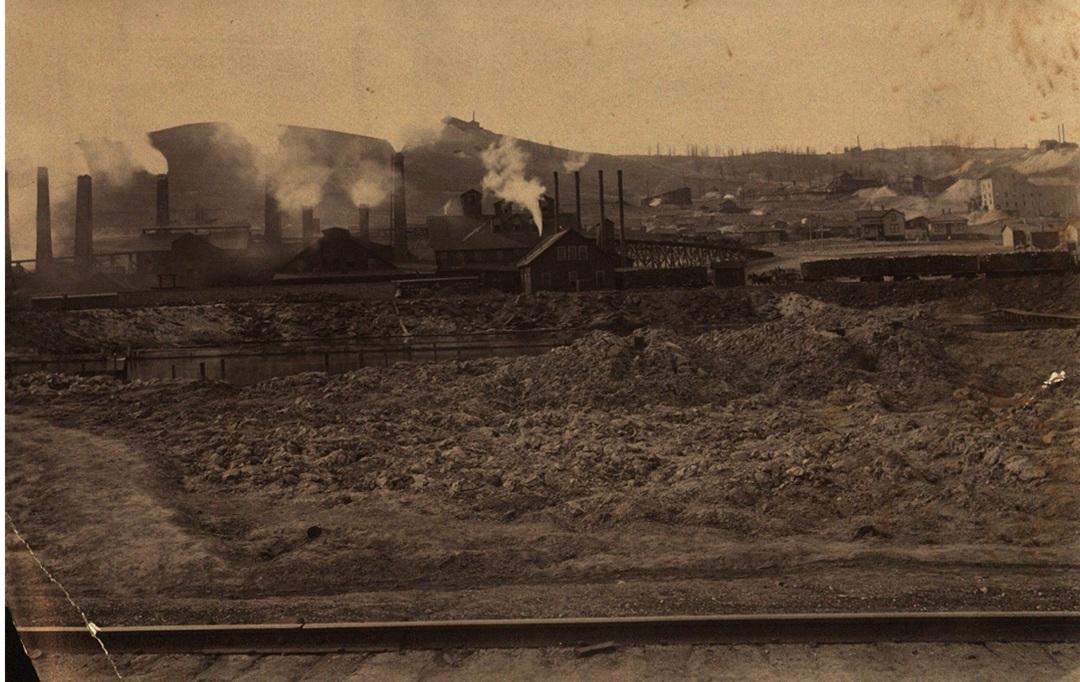
    <title type="html"><![CDATA[Smelting]]></title>
    <summary type="html"><![CDATA[<p><strong><em>Robert Peele’s 1916 Mining Engineering Handbook defines ore: “An ore is a metal-bearing mineral, or aggregate of such minerals, mixed with barren matter, called ‘gangue,’ and capable of being mined at a profit.” </em></strong></p><img src="https://storyofbutte.org/files/fullsize/ef57c4036421799ef63fb90bd425e62e.jpg" alt="Slag Canyon" /><br/><p>The metal-bearing minerals in the Butte Hill include copper sulfides as well as the sulfides of other base metals, like zinc and lead. The copper sulfides are chemical compounds consisting of atoms of copper and sulfur as well as other elements, like iron and arsenic, and with names like chalcocite (Cu2S), bornite (Cu5FeS4), enargite (Cu3AsS4), and chalcopyrite (CuFeS2). To convert ore into metallic copper, those molecules of copper sulfide must be broken apart to yield pure copper and to dispose of the other elements. Doing that requires smelting, usually in furnaces to raise the temperature so that oxygen in the atmosphere can combine with the sulfur and other elements to liberate the copper. </p><p>Some of the first copper ores found in the Butte Hill were rich enough in copper and other metals that they could be shipped to distant smelters for treatment and still yield a profit, but miners knew that most of Butte’s ores would have to be smelted locally to be profitable. The Montana Copper Company built Butte’s first successful copper smelter in 1879. Within a few years, there were another half dozen copper smelters in Butte. Operators of each of these smelters recognized that they could be more profitable if they built concentrators to mechanically separate much of the gangue from the metal-bearing minerals before sending the concentrates to the smelter. Through the end of the nineteenth century and into the twentieth, Butte was a major smelting center.</p><p>When Marcus Daly launched his Anaconda Company, he recognized that water, needed for concentrating, was scarce in Butte, and that Butte’s valley location had a limited capacity for the smoke that smelting produced. He decided to build a smelter at his new town of Anaconda twenty-six miles west of Butte along Warm Springs Creek. The first Anaconda smelter went into operation in 1884 with a capacity five times greater than any of the Butte smelters. He built another smelter at Anaconda in 1889. Both of those smelters were replaced in 1902 by the more-modern Washoe Reduction Works. Gradually, the Butte smelters closed, with the last one closing in the 1920s. Ore was sent to Anaconda for smelting, where that smelter had grown to giant proportions. Consequently, Butte came to be known as the “Mining City” and Anaconda as the “Smelter City.”</p><p>Almost all traces of Butte’s once prominent smelting industry have been wiped from the landscape. The one exception is the “slag canyon” through which Silver Bow Creek passes just west of Montana Street, where the Butte Reduction Works once stood. Smelters produce two sets of waste products: smoke, which carries sulfur dioxide, arsenic, flue dust, etc.; and slag, which is a molten waste from the smelting furnaces carrying mostly silica and iron but also other metals. When the Butte Reduction Works was operating, it had to control the flow of Silver Bow Creek through its property and also address the complaints of downstream farmers who claimed that tailings from the concentrator were damaging their lands and crops along the stream. The Butte Reduction Works used molten slag, poured into formwork, to build the walls that form the canyon, and also to build slag walls visible further west to impound the tailings and prevent them from flowing downstream. The tailings were reprocessed in the late 1910s, leaving the slag walls as the only physical remains of Butte’s once important smelting industry.</p><p><em><strong><a href="https://storyofbutte.org/items/show/3505">For more (including 8 images) view the original article</a></strong></em></p>]]></summary>
    <published>2025-01-07T00:14:06+00:00</published>
    <updated>2026-04-17T19:58:10+00:00</updated>
    <link rel="alternate" type="text/html" href="https://storyofbutte.org/items/show/3505"/>
    <id>https://storyofbutte.org/items/show/3505</id>
    <author>
      <name>Fred Quivik</name>
    </author>
  </entry>
  <entry>
    <title type="html"><![CDATA[Milling and Concentrating]]></title>
    <summary type="html"><![CDATA[<p><strong><em>The last steps in the process of making copper metal took place at a smelter, but most copper ores had to be concentrated before being sent to the smelter.</em></strong></p><img src="https://storyofbutte.org/files/fullsize/708e648c52cac0b635b5595d4412088c.jpg" alt="Clyde E. Weed Concentrator" /><br/><p>In the early years (before 1915), copper ores were concentrated using gravity methods. First, the ore was crushed and ground to an appropriate particle size. Then the crushed ore, in a slurry with water, was sub-divided into streams of similar particle size (½-in. to ¾-in., ¼-in. to ½-in., etc.). Each stream was then sent to a set of jigs, mechanical devices that allow denser metal-bearing particles to sink in agitated water, while non-metal-bearing particles will remain suspended in the water. The dense particles were gathered as concentrate, which had a higher copper content than the raw ore, and the less-dense particles were flushed away as tailings. The particle size of tailings can range from coarse, as large as ¾-inch, to as fine as sand and even finer, to the consistency of powder (called slimes). Because gravity concentration is not 100% effective, there were still some metal values in the tailings, especially the fine tailings. </p><p>While jigs work well on relatively coarse particle sizes, they do not work well on fine solids. Concentrators therefore used other machines, called tables and vanners, that passed a slurry of fine solids and water over the textured surface of a tilted table or the surface of a moving belt with a textured surface and/or a shaking motion. These methods recovered additional copper, but the assay value of slime tailings was still often about the same as the raw ore, meaning that considerable value was lost with slime tailings.</p><p>Early Butte copper concentrators often had a ratio of concentration of 2.5:1, which meant that 2.5 tons of ore yielded one ton of concentrate (and 1.5 tons of tailings). As much as 20% of the copper in the ore was lost to tailings that were discharged in dumps near the concentrator. Because companies were not particularly careful to prevent tailings from washing downstream, much of the tailings ended up on the fields of farmers downstream along Silver Bow Creek and the Clark Fork, who used the water for irrigation. Slimes were particularly damaging to land and crops, and complaints by farmers in the early twentieth century led the Butte Reduction Works to impound its tailings behind walls built of molten slag. </p><p>The effectiveness of concentration improved greatly after 1915 at Anaconda with the introduction of flotation, a process that adds chemicals, called reagents, to a slurry of finely ground ore so that the metal-bearing particles will adhere to bubbles rising through the slurry to the surface, while the particles of gangue (the non-metal-bearing rock) remain suspended in the slurry. With flotation, the Anaconda concentrator was able to recover as much as 96% of the copper. The froth of bubbles and fine solids could then be gathered from the surface of the slurry for smelting. The ratio of concentration for flotation changed to about 10:1, meaning 10 tons of ore yielded 1 ton of concentrate and 9 tons of tailings. Flotation tailings were much finer than gravity tailings, but they also had a much lower copper content.</p><p>After the Berkeley Pit went into operation in 1955, the Anaconda Company began to run out of space to store all its tailings near the Washoe Reduction Works at Anaconda. Moreover, it became uneconomical to haul low-grade ore by rail to Anaconda, so the company built a new concentrator on the south rim of the Berkeley Pit. Named for Clyde E. Weed, mining engineer and Anaconda Company president, the new concentrator went into operation in 1964. Using flotation, it now treats the ore Montana Resources mines from the East Continental Pit. To dispose of the tailings, the company used (and still uses) waste rock from the open-pit mining operations to build an earthen embankment across what was once the upper Silver Bow Creek watershed north of the Berkeley Pit. That earthen embankment now towers over the Berkeley Pit and is easily visible from the Berkeley Pit viewing stand and most areas on “The Flat.” The tailings behind it are called the Yankee Doodle tailings pond, named for Yankee Doodle Gulch, one of two tributaries that once formed Silver Bow Creek.</p><p><em><strong><a href="https://storyofbutte.org/items/show/3503">For more (including 8 images) view the original article</a></strong></em></p>]]></summary>
    <published>2025-01-06T23:36:34+00:00</published>
    <updated>2026-04-17T19:58:10+00:00</updated>
    <link rel="alternate" type="text/html" href="https://storyofbutte.org/items/show/3503"/>
    <id>https://storyofbutte.org/items/show/3503</id>
    <author>
      <name>Fred Quivik</name>
    </author>
  </entry>
  <entry>
    <title type="html"><![CDATA[Mine Timbers]]></title>
    <summary type="html"><![CDATA[<p><strong><em>Some mine workings on the Butte Hill passed through stable rock, and some passed through unstable ground that needed to be supported by mine timbers. Shafts also needed to be timbered to support the guides for the cages and skips used for hoisting men and ore.</em></strong></p><img src="https://storyofbutte.org/files/fullsize/d7b7d5f1d3fd828d7648611f54d0aa2f.jpg" alt=" Framing shop at the Anselmo mine. " /><br/><p> The greatest need for mine timbers was in the stopes, the large underground voids created as miners removed the ore from a vein. Miners stood on timber structures in a stope as they worked upward along the vein, and then the structure of mine timbers served to stabilize the walls of the stope until it could be backfilled with waste rock from elsewhere in the mine. All of these uses for mine timbers created a huge demand for trees to cut, which Anaconda Copper Mining (ACM) and other companies met initially by logging all the suitable timber in the Butte area and then by acquiring timber and timberlands elsewhere in Montana. In 1907 ACM acquired forested sections of land from the Northern Pacific Railway that NP had originally received from the U.S. government to capitalize construction of its transcontinental railroad.</p><p>Every mineyard in Butte once had its own framing shop for making mine timbers. The Butte mines used what were called square-set timbers, which were logs sawn to make them square instead of round, and then sawn at the ends so that the tops of posts and the ends of horizontal members would fit together snugly and stay together under pressure, without needing to be nailed. Beginning in the 1880s, the Gagnon mine began to let the timbers remain round, milling only the ends where the timbers fit together. This practice spread to the other mines so that in the early 1900s, virtually all Anaconda mines used round timbers. After the turn of the twentieth century, W. A. Clark and ACM both established centralized timber-framing mills, Clark’s at the West Steward mine and ACM’s at Rocker, three miles west of Butte. ACM’s Rocker mill, built in 1902, was designed specifically to cut round timbers rather than squared timbers. Although the centralized mills made timbers of standardized size for mines on the Butte Hill, each mine still needed the capacity to make non-standard timbers for its own workings.</p><p>In the early years, untreated mine timbers were placed underground to shore up unstable ground, but hot, humid conditions led to their rapid deterioration. At the turn of the twentieth century, the conservation movement began advocating for the preservation of timber in many applications to reduce demand for cutting the nation’s forest resources. The U.S. Forest Service became one of the leading advocates of conservation, both through improved forestry practices and by encouraging the producers of railroad ties and mine timbers to treat the wood with preservatives (creosote, made from coal tar and shipped to the nearby community of Rocker by rail) to relieve the pressure on the nation’s forests to cut more trees. The Forest Service and ACM cooperated in expanding the Rocker mill to function as a timber-treating plant. The Forest Service helped design the plant so it could disseminate technical information about the process to other potential adopters of wood preservation, and ACM participated in the project so it could save money on mine timbers.</p><p>The only timber-framing shop left in Butte is at the Anselmo mine. It stands just west of the headframe, housing a cut-off saw like that shown in the photo below of the framing shop at the West Steward mine. Operating west of the core mining area on the Butte Hill, the Anselmo Mining Company had been independent until ACM acquired it and took control of its operations in the late 1920s. Meanwhile the Anselmo had its own timber treating plant just northeast of the mineyard, which stood until the early stages of the Superfund remediation on the Butte Hill.</p><p><em><strong><a href="https://storyofbutte.org/items/show/3502">For more (including 8 images) view the original article</a></strong></em></p>]]></summary>
    <published>2025-01-06T23:14:54+00:00</published>
    <updated>2026-04-17T19:58:10+00:00</updated>
    <link rel="alternate" type="text/html" href="https://storyofbutte.org/items/show/3502"/>
    <id>https://storyofbutte.org/items/show/3502</id>
    <author>
      <name>Fred Quivik</name>
    </author>
  </entry>
  <entry>
    <title type="html"><![CDATA[Mine Ventilation]]></title>
    <summary type="html"><![CDATA[<p><strong><em>Mine ventilation has always been essential to creating underground conditions in which miners can work.</em></strong></p><img src="https://storyofbutte.org/files/fullsize/a43c2ced26fc61e1b205f7fa62e2f9b5.jpg" alt="Concrete fan housing at the Desperation shaft, northeast corner of West Quartz and Western." /><br/><p>In addition to supplying the necessary oxygen for miners to breathe, ventilation must maintain adequate temperature and humidity and must carry away the dust and gases created during blasting. Mines were wet, so evaporation increased humidity underground. The deeper a mine gets, the closer it is to the center of the Earth, so temperatures rise. In addition, rotting mine timbers and the oxidation of sulfide minerals generated heat and raised the air temperature in Butte’s underground workings. Using more electrical equipment underground also increased the heat generated. Finally, on-going underground mine fires contributed heat within some areas of the Butte Hill. An 1889 fire in the St. Lawrence mine, for example, continued burning for at least three decades. </p><p>Prior to 1910, mines in Butte relied on what they called natural ventilation, which could be enhanced if adjoining shafts were connected by means of their underground workings. Such connections would allow a shaft that was lower on the hill to function as a downcast shaft, supplying fresh air to the workings, and a shaft higher on the hill would be an upcast shaft, allowing warm air from the workings to rise through the shaft. Another source of ventilation was the compressed air released underground during the operation of rock drills.</p><p>In 1910, after most of the big mines on the Butte Hill were consolidated under the ownership and operation of Anaconda Copper Mining Company (ACM), the company converted several mines from being shafts hoisting ore to serving as ventilation shafts by installing giant fans to draw large volumes of air from the underground workings, which were connected to the workings of nearby mines. That meant the remaining producing shafts became downcast shafts by means of the artificial ventilation. Among mines that were converted to ventilation shafts by February 1911 were the Corra, Gambetta, Parnell, and East Steward.</p><p>By 1920, ACM had consolidated even more mining companies in Butte, and it operated 28 mines on the Butte Hill. ACM had also adopted the method of using canvas pipe and fans underground to convey fresh air to the ends of mine workings.</p><p>Around 1950, as ACM was increasing zinc production from the Anselmo mine, it decided to enhance ventilation of the Anselmo’s underground workings by driving a shaft on the Volunteer mining claim near the BA&P tracks and 1,600 feet to the southwest of the Anselmo shaft. Miners connected the new shaft underground to the 800 level of the Anselmo shaft. Workers on the project called it the Desperation shaft because of the problems they encountered with water. The concrete fan housing atop the Desperation shaft survives and is the last surviving structure of its kind in Butte.</p><p><em><strong><a href="https://storyofbutte.org/items/show/3501">For more (including 3 images) view the original article</a></strong></em></p>]]></summary>
    <published>2025-01-06T21:18:58+00:00</published>
    <updated>2026-04-17T19:58:10+00:00</updated>
    <link rel="alternate" type="text/html" href="https://storyofbutte.org/items/show/3501"/>
    <id>https://storyofbutte.org/items/show/3501</id>
    <author>
      <name>Fred Quivik</name>
    </author>
  </entry>
  <entry>
    <title type="html"><![CDATA[Hoisting Engines and Hoist Houses]]></title>
    <summary type="html"><![CDATA[<p><strong><em>Mines in Butte employed a wide variety of hoisting mechanisms over the decades. By the 1930s, the most common hoisting engine was powered by an electric motor. The electric hoist at the Orphan Girl mine, World Museum of Mining, is the most easily accessible hoisting engine on the Butte Hill. </em></strong></p><img src="https://storyofbutte.org/files/fullsize/cf9f969826e8f4db4b514d2c0a568396.jpg" alt="Electric hoist at the Orphan Girl mine, " /><br/><p>Tours of the interiors of other hoist houses may occasionally be arranged, including the compressed air hoists (formerly steam) at the Original and the Steward, and the electric hoists at the Anselmo and Mountain Consolidated.</p><p>The simplest form of mining is the excavation of mineral on the Earth’s surface, but sometimes the mineral being sought is deep enough that it is not practical to get to it by digging a large hole in the ground all the way down to the ore body. An alternative is to dig a shaft, like a well, that allows miners to descend to the level where the ore or other desired mineral can be broken free and then hoisted to the surface. To hoist buckets of ore from the mine, early shaft mines employed a windlass (hand-cranked winding drum) placed directly over the shaft, similar to that employed to lift a bucket of water from a well. An early improvement was the horse whim, a drum for winding the rope that was powered by one or more horses walking in a circle around the drum. That contraption was too large to be placed directly over a shaft, so it had to be set on the ground next to the shaft. In order that a rope could be extended down the shaft for hoisting ore, it had to be run over the top of a grooved pulley wheel (called a sheave) and then run to the whim next to the shaft for winding. The simple structure supporting the sheave, A-frame or otherwise, was the beginning of the modern headframe. Such arrangements go back more than 500 years in Europe.</p><p>In the years and centuries before Butte mining, ore was hoisted from shafts in buckets, and miners descended into mines either by ladder or (unsafely) in the buckets. By the time shaft mining began in Butte, a new “vehicle,” called a cage, was standard in the shaft. It was a platform on which miners could stand to ride down or up the shaft and onto which miners could place a small ore car filled with ore to be hoisted. The ore cars were run along tracks underground to haul ore and waste rock from the working face of the mine to the shaft. As the capacity of hoist engines increased, the mining industry developed a container like a giant bucket, called a skip, that could hoist a larger volume of ore than a small ore car could hoist. Cages were still used to lower miners and materials (like tools and mine timbers) into the mine, but early cages had little protection for miners. In 1897, the Montana legislature passed a bill requiring safety bonnets and sides on all cages in shafts deeper than 300 feet, which included most of the big mines in Butte.</p><p>Steam power increased the speed and hoisting capacity of the mine. When steam-powered hoisting began in Butte in the 1870s, the boilers, steam engines, and headframes were small enough that they could all be housed within a single timber-framed building. As mine production increased, however, the size of steam-powered hoisting engines grew, as did the activities that had to be conducted around the collar of the shaft and, in time, a new configuration arose, with the taller, unenclosed headframe standing over the shaft, and the hoisting engine housed in a free-standing industrial building adjacent to the headframe and shaft. The large hoisting engines in Butte grew to have two side-by-side drums, one overshot and one undershot. When the drums operated in tandem, that allowed for the cable on one drum to be let out while the other was wound up. That in turn allowed the weight of the cable and skip of one drum to counterbalance the weight of the cable and skip on the other drum, thereby reducing the load that the engine had to lift. The surviving hoist houses in Butte are all industrial buildings built either of brick or of steel frame with corrugated steel siding. They have windows for daylighting of the interior, but the windows did not give the hoist operator a view of the mineshaft. Miners underground, surface workers, and the hoist operator communicated with each other by a system of bells.</p><p>In the early twentieth century, the Butte mines began to modify their steam hoists to be powered by compressed air, and then they converted to electric hoists. </p><p><em><strong><a href="https://storyofbutte.org/items/show/3500">For more (including 8 images) view the original article</a></strong></em></p>]]></summary>
    <published>2025-01-06T20:37:25+00:00</published>
    <updated>2026-04-17T19:58:10+00:00</updated>
    <link rel="alternate" type="text/html" href="https://storyofbutte.org/items/show/3500"/>
    <id>https://storyofbutte.org/items/show/3500</id>
    <author>
      <name>Fred Quivik</name>
    </author>
  </entry>
</feed>